
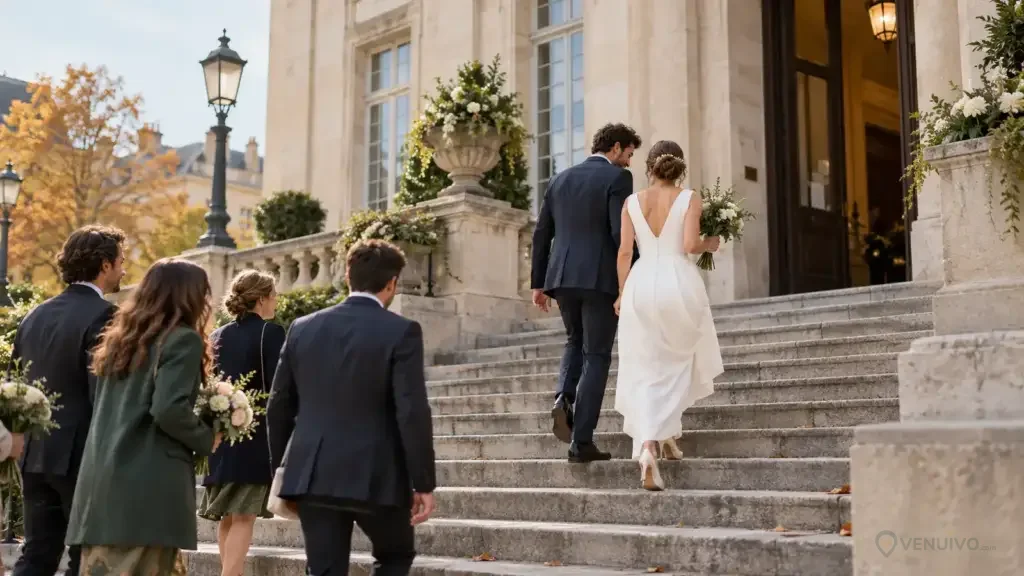
Civil marriage is the only ceremony that officially creates marriage before the law. To organize it without stress, it is necessary to distinguish three subjects: the legal conditions, the file requested by the civil registry and the logistics of the big day. The rules are not identical in France, Belgium and Switzerland; The municipality or the competent office therefore remains the decisive interlocutor.
This guide provides a concrete method for preparing the case, selecting witnesses, setting a realistic timetable, and linking the civil ceremony to the reception. It does not replace the personalised instructions of the administration, in particular in the case of foreign nationality, documents drawn up abroad, divorce, widowhood or protection measures.
Start by identifying the competent authority
Before booking a room or printing the invitations, check where the ceremony can legally take place. This first step determines the administration to contact, the supporting documents to be provided and the available slots.
In France, the application is submitted to the town hall of the chosen municipality according to the applicable rules of domicile or residence. In Belgium, the declaration of marriage is made to the civil registrar of the competent municipality. In Switzerland, the preparatory procedure begins at the civil registry office of the place of residence or, in certain situations, at a Swiss representation abroad.
First consult the official page of your municipality, then call the civil registry office if your situation has an international element. A generic list found on a blog does not allow you to know whether a sworn translation, an apostille, a legalization or a complementary document will be requested.
Compare the major stages in France, Belgium and Switzerland
| Country | Central approach | Official deadline or window to be aware of | Witnesses |
|---|---|---|---|
| France | Submission of a complete file to the town hall, then publication of the banns | Banns are posted for 10 days; The celebration cannot take place before the 10th day following their publication | 2 minimum and 4 maximum |
| Belgium | Declaration of marriage at the municipal civil registry | The declaration must be made at least 14 days before the date; The celebration takes place no later than 6 months after the declaration | 0 to 4 witnesses |
| Switzerland | Preparatory procedure at the civil registry office | After validation of the formalities, the couple has 3 months to get married | 2 adult witnesses capable of discernment |
These benchmarks come from the official portals consulted on October 21, 2026: Service-Public.fr for France, Belgium.be for Belgium and ch.ch for Switzerland. They provide a national framework; The appointment procedures and practical parts may vary locally.

Building the file without waiting until the last moment
An incomplete file may delay the confirmation of the date. Create a monitoring table with one line per document, its holder, its date of issue, its possible expiry period, the language of the document and the status of its translation or legalisation.
Frequently requested items
- a valid identity document for each future spouse;
- proof of address or residence accepted by the administration;
- the necessary marital status information and, depending on the country or situation, a birth certificate;
- information and copies of witness identification documents where required;
- supporting documents related to a previous union, widowhood or a particular situation;
- documents relating to a marriage contract when a notarial procedure is provided;
- translations, legalisations or apostilles requested for foreign documents.
Do not order all the documents several months in advance without checking their validity period. In France, for example, the age allowed for a birth certificate depends in particular on its place of issue. The Service-Public portal offers a personalised route; The town hall confirms the list that is actually applicable.
The right work order
- ask for the official list corresponding to your situation;
- identify time-consuming parts to obtain, especially abroad;
- make the drop-off appointment if the municipality requires it;
- check the surnames, first names, dates and places on each document;
- have it translated or legalized only according to the requirements received;
- Keep a digital copy and a hard copy of the final file.
Prepare a realistic schedule
The minimum legal period is not a recommended organisational period. It does not take into account slots already booked, the analysis of an international file, an interview requested by the civil registry or a document to be corrected.
| Timing | Recommended action | Point of vigilance |
|---|---|---|
| Before any firm reservation | Check the competent municipality and the conditions of the file | A desired date is not yet a confirmed date |
| Several months before | Gather complex documents and contact, if necessary, the notary or translator | Don't anticipate a document that will expire before filing |
| At the depot | Have the file checked and ask for the operation of the summons | Write down the name of the department, contact information and remaining parts |
| After validation | Confirm the service providers, the transports and the precise route | Use the official schedule provided by the administration |
| A week before | Read instructions, confirm witnesses and prepare identification documents | Provide a contact capable of managing a delay without soliciting the couple |
To coordinate this schedule with the entire project, also use the guide VENUIVO on the Essential steps in planning a wedding. It allows you to align the administrative procedures with the room, the caterer and the invitations.
Choosing witnesses according to the rules of the country
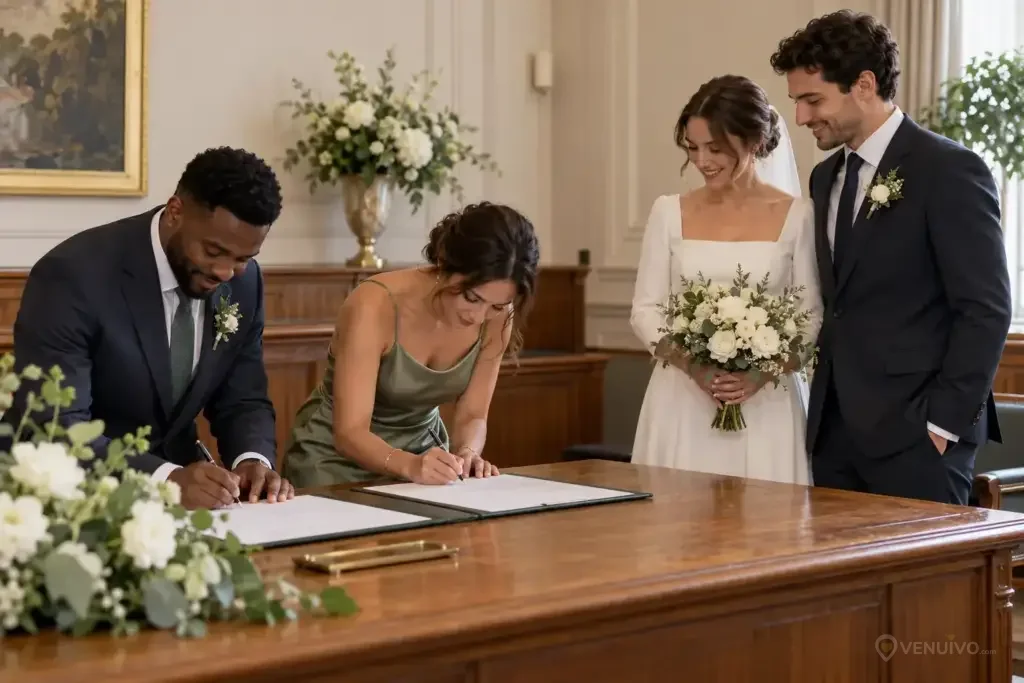
The legal role of witnesses should not be confused with that of bridesmaids or groomsmen. In France, witnesses are mandatory: the couple chooses between two and four together. They must be of legal age or emancipated and present their identity document. The choice can be changed until the official celebration, but it is better to notify the town hall as soon as a change is known.
In Belgium, the couple can choose not to have any witnesses or to appoint up to four. In Switzerland, the ceremony takes place with two witnesses who are adults and capable of discernment. In all cases, confirm the local rules and the language understood by witnesses. If an interpreter is needed, ask the administration what conditions they must meet.
Information to be confirmed with each witness
- name and surnames exactly as on the identity document;
- date and place of birth;
- address and profession when requested;
- presence during the whole ceremony;
- original identity document available on the day;
- meeting time and point, with sufficient margin.
Understand the Civil Ceremony
The civil ceremony is generally short, but its course depends on the authority and the municipality. Allow time for the reception, checking identities, entering the room, reading the legal provisions, collecting consents and signatures.
A typical course to anticipate
- arrival of the couple and witnesses at the indicated point;
- installation of guests in the room accessible to the public;
- presentation by the civil registrar;
- reading of texts and reminder of the obligations of marriage;
- obtaining the consent of each future spouse;
- signature of the deed by the persons concerned;
- delivery or explanation of the documents issued after the ceremony;
- Organized outing without blocking the next slot.
In France, the celebration is done by the mayor or a deputy, in the presence of the couple and witnesses. A family record book is issued at the time of a marriage celebrated in France. In Switzerland, the marriage certificate submitted at the end confirms the place and date as well as the names of the spouses before and after the marriage. Always check what will actually be delivered or sent by your administration.
Connecting the town hall to the reception
Two organizations are possible: to celebrate the civil wedding and the reception on the same day, or to separate the two dates. The same day offers symbolic continuity, but imposes a rigorous schedule. Two dates give more flexibility and allow for a more intimate civil ceremony.
If the town hall and the reception venue are far away, calculate the actual route at the relevant time, parking, walking from the car park and the time needed for exit photos. The guide to Shuttle and guest transportation Helps organize rotations and returns.
Allow a margin without unnecessarily lengthening the day
- ask for the time when the couple and witnesses are due to appear;
- designate a person to welcome latecomers;
- send a precise map rather than just an address;
- provide a covered waiting area if the group arrives early;
- inform the photographer of any restrictions in the room;
- Avoid scheduling the cocktail immediately after the theoretical time of exit.
Organize a personalized celebration without interfering with the civil act
The possibilities for music, speeches, exchange of rings or photography vary depending on the municipality. Ask what's allowed before you plan a surprise. A town hall can have several weddings in a row and not have the time or equipment desired.
For a long and very personal ceremony, it is often easier to reserve the texts, rituals and interventions for a separate celebration. The guide VENUIVO on the Secular ceremony explains how to construct this second stage without confusing it with the legal ceremony.
Anticipating international situations
A foreign nationality, residence in another country or a document issued abroad does not make marriage impossible, but can lengthen the preparation. The rules of form, matrimonial capacity, translation and recognition must be checked with the competent authorities.
Don't entrust an irreplaceable original without getting a receipt. Ask if a certified copy is allowed, who can do the translation, whether an apostille or legalization is required, and how the marriage will then be registered in the other country. For a complex situation, a notary, a lawyer or the competent consulate can complete the information on the civil status.
Helpful questions to ask in writing
- which version of each act is accepted;
- what maximum seniority applies on the day of filing;
- which authority must certify the translation;
- whether the originals will be kept or returned;
- whether a certificate of custom or matrimonial capacity is required;
- What steps to take after the celebration.

Final Civil Wedding Checklist
- The competent administration and the possibility of celebrating in the municipality are confirmed.
- The list of documents corresponds exactly to the couple's situation.
- Foreign documents are translated and legalized according to the instructions received.
- The file is complete and the date has been confirmed by the civil registry.
- Witnesses comply with local rules and their information is up to date.
- The couple, the witnesses and the possible interpreter know the time of the summons.
- Original identification documents are ready.
- Transportation between the town hall and the reception takes into account parking and fragile guests.
- The photographer knows the rules of the room and the time available.
- Someone other than the couple handles calls and delays.
- The steps to be taken after the marriage are noted.
If multiple providers and locations need to be coordinated, the guide for Choosing a wedding planner helps define responsibilities and planning for the big day.
Frequently asked questions about civil marriage
Can I book the reception before having the date of the town hall?
You can take options, but avoid non-changeable commitments until the administration has confirmed the slot. Ask claimants what conditions apply if the calendar schedule changes.
Can the civil ceremony take place after a religious ceremony?
The rules depend on the country. In France, civil marriage must precede any religious ceremony. In Switzerland, the official portal indicates that a religious or free ceremony can be celebrated after a civil wedding. Check the rule applicable to the place of celebration.
How long does a ceremony last at the town hall?
There is no single duration. It depends on the municipality, the number of weddings scheduled and the elements authorized. Ask for an estimate from the civil registry office and build the schedule with a margin.
Can we change the baton at the last minute?
In France, the choice can be changed until the official celebration, but the town hall must have the information and identity document of the new witness. For Belgium and Switzerland, request the local procedure immediately.
Do I need a marriage contract to submit the application?
A contract is not mandatory in all situations. If the couple chooses a regime requiring a notarial deed, the notary indicates the timetable and the supporting documents to be sent to the civil registry. An international situation deserves personal advice.
What if a document arrives too late?
Notify the civil registry without delay. Only the administration can say whether the case can be continued, whether an equivalent document is admitted or whether the date should be moved. Never modify a document or present a copy that is not certified as an original.
Conclusion: securing the law before logistics
A serene civil wedding starts with a simple rule: get the exact requirements from the administration before locking down the day. Once the file is complete and the date confirmed, the couple can arrange witnesses, transportation, photos, and reception with reliable information.
Keep a written follow-up, check foreign documents early enough, and leave a margin between the ceremony and the reception. The town hall or the civil registry office remains the final source for your situation; Providers can then build around this framework without the risk of contradiction.