
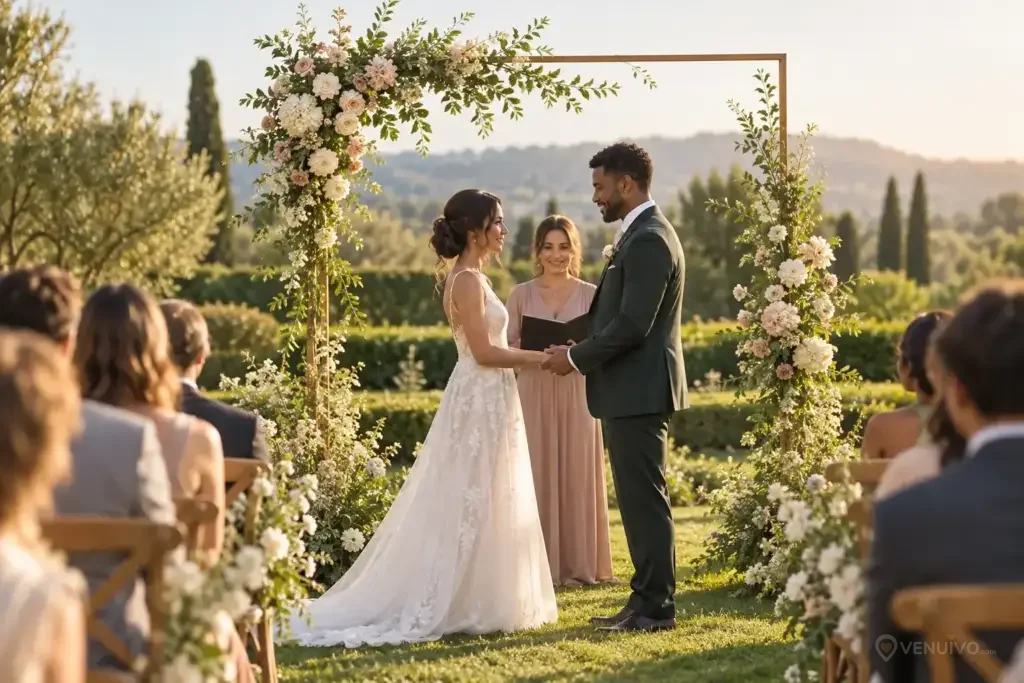
A successful secular wedding ceremony is based on three things: a clear common thread, short, well-prepared contributions, and discreet technical organization. It does not consist in accumulating speeches or rituals. It should tell your story, involve the right people, and leave enough room for emotion without losing the guests' attention.
This guide helps you to build the timeline, choose the officiant, prepare the vows, select a ritual that suits you and coordinate the place, the sound, the music, photography and the weather backup plan.
Secular ceremony and civil marriage: what is the difference?
In France, the secular ceremony is symbolic: it does not replace the civil celebration. A marriage with legal value is celebrated publicly by the civil registrar. The official Service-Public guide to marriage in France explains the conditions, filing the application and the civil ceremony at the town hall. Articles 165 and 75 of the Civil Code govern the civil ceremony and the presence of witnesses.
The secular ceremony can therefore be held before or after the civil ceremony, depending on your schedule, but it should not be presented as the act that legally creates the marriage. On the other hand, it offers great freedom in the choice of venue, tone, readings, music and participation by loved ones. If your wedding is taking place outside of France, check the local rules with the relevant authority.
Start with intention, not rituals
Before writing the program, formulate in one sentence what the guests need to understand or feel. For example: celebrating how far we have come, reuniting two families, passing on a common promise or honouring several cultures. This sentence becomes your filter. An intervention, music, or ritual that does not serve it can be shortened or removed.
Then decide on the general register: intimate, joyful, solemn, participatory, humorous or mixing several tones. It is possible to alternate between emotion and lightness, as long as you avoid abrupt shifts. A frank exchange with the speakers limits overly private anecdotes, embarrassing jokes and repetitions.
Choosing the officiant of the secular ceremony
A friend or family member, or a professional?
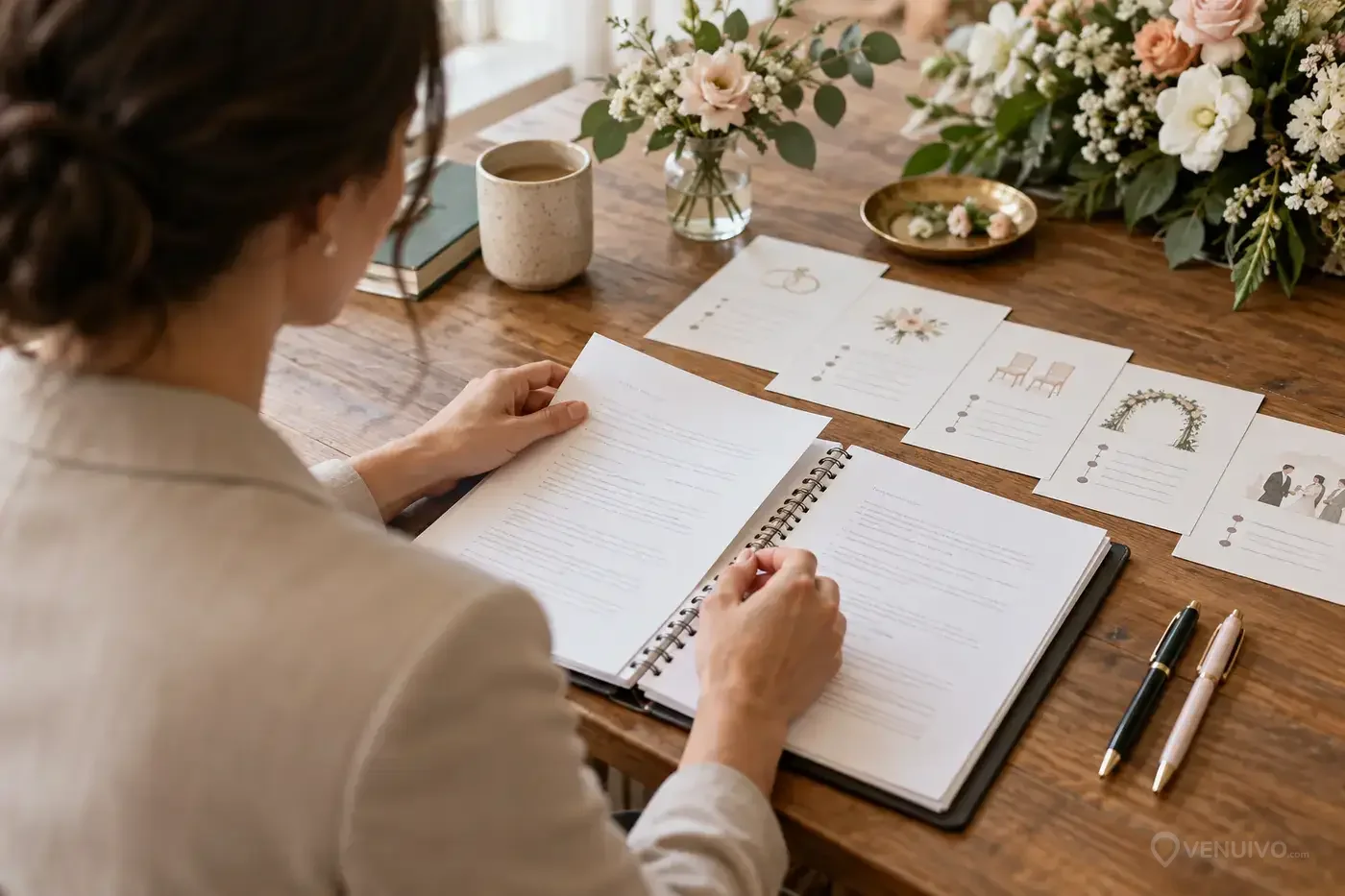
A friend or family member knows your story and brings a very personal presence. However, they must be willing to prepare the script, contact the speakers, keep to the schedule and speak in front of a group. A professional officiant brings a method, an outside view and more perspective, but it is important to check that their writing and speaking style suits you as a couple.
| Option | Main advantage | Point to confirm |
|---|---|---|
| A friend or family member | First-hand knowledge of the couple | Preparation, oral fluency and availability |
| Two loved ones | Complementary voices and relays | Clear division of roles to avoid repetition |
| A professional | Method, neutrality and rhythm management | Compatibility of tone and scope of the contract |
In every case, appoint one person to manage the running order. They keep the final script, know who is speaking, cue the music and decide whether to adapt a sequence if there is a delay or uncertain weather.
Questions to ask before confirming
- Who writes each part and who validates the final version?
- How many appointments or rehearsals are planned?
- Who contacts the speakers and follows up on outstanding texts?
- How will the microphone, music and unexpected issues be managed?
- What happens if the officiant is unavailable?
- Is the full script given to the couple after the ceremony?
What timeline should you plan for a secular ceremony?
There is no mandatory duration. To maintain a natural rhythm, build blocks and test them out loud. The template below is an adaptable base, not a standard. A concise ceremony can be very strong; a longer ceremony only works if the sequences are varied and useful.
| Sequence | Possible content | Vigilance |
|---|---|---|
| Welcome | Welcome message and practical instructions | Getting to the point quickly |
| Entrances | Couple, wedding party or joint entrance | Testing music and distances |
| Couple's history | Meeting, steps, values | Avoid exhaustive biography |
| Words of relatives | One to three complementary testimonies | Set an angle and length for each |
| Vows | Personal commitments or a shared text | Provide a backup copy |
| Symbolic ritual | A gesture chosen for its meaning | Check hardware and visibility |
| Conclusion and exit | Final phrase, music, transition | Clearly state the following |
Add the movements to the running order, music changes and time needed to give or take back a microphone. Simple repetition can identify lengths, names that are difficult to pronounce, and times when two people are likely to speak at the same time.
Writing speeches without repeating the same story
Assign a different angle to each speaker: childhood, encounter, a quality of the couple, family life, friendship or a wish for the future. Ask for a written text or at least an outline. The objective is not to censor relatives, but to preserve coherence and avoid four versions of the same anecdote.
Give a clear boundary and ask everyone to read their lines aloud before the wedding. A page can seem short on the screen and become long when spoken with pauses. The officiant must also know if a passage is a surprise, in order to prepare for the transition without revealing it.
Prepare personal, easy-to-say vows
Good vows are concrete. You can follow a four-movement structure: what you recognize in the other person, a memory that illustrates it, the commitments you choose and the way you imagine the future. Avoid promising what no one can guarantee; focus on practical, everyday commitments.
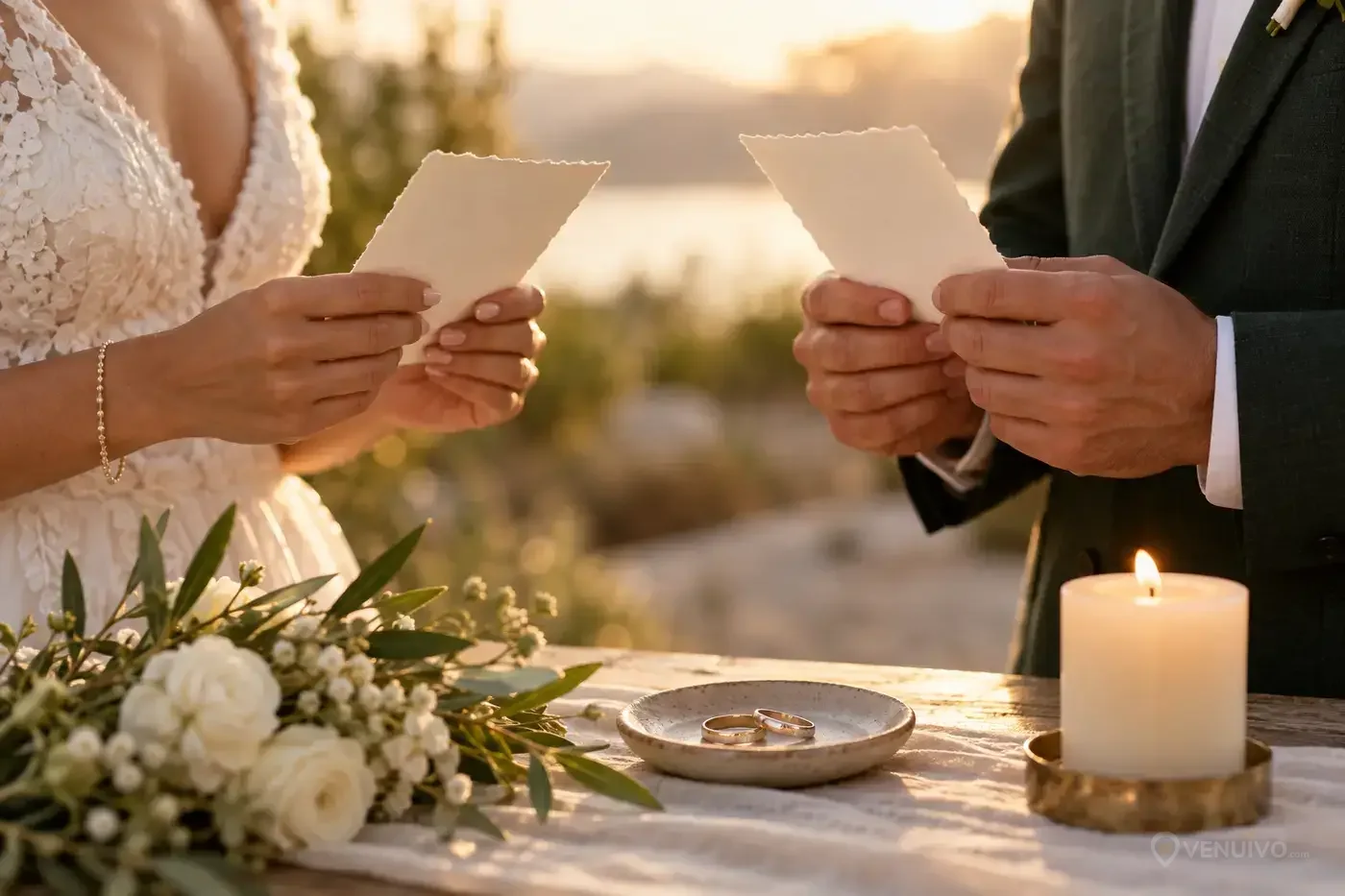
Decide if the two texts will be close in length, whether they will be heard for the first time on the ceremony day, and if certain passages should be kept private. Print them in legible characters on a stable medium and give a copy to the officiant. If emotion interrupts the reading, breathing or asking the officiant to continue does not detract from the sincerity of the moment.
Choosing a symbolic ritual that makes sense
The ritual should extend your story rather than fill a void. Consider the location, the wind, the presence of children and the equipment. A complex or fragile gesture can become stressful in front of guests.
| Ritual | What it can symbolize | Helpful preparation |
|---|---|---|
| Common candle | A shared project | Wind protection and venue rules |
| Ribbons or handfasting | Links and commitments | Order of the ribbons and who places them |
| Memory Box | Memory to be reopened later | Prepared objects and tested closure |
| Planting | The couple's growth | Stable support, little soil and cleaning |
| Collective text | Support from loved ones | Simple answer explained in advance |
Check with the venue for rules regarding flames, petals, liquids, confetti, plantings, and hanging objects. Plan a simplified version if conditions do not allow the planned ritual.
Setting up the space: visibility, comfort and accessibility
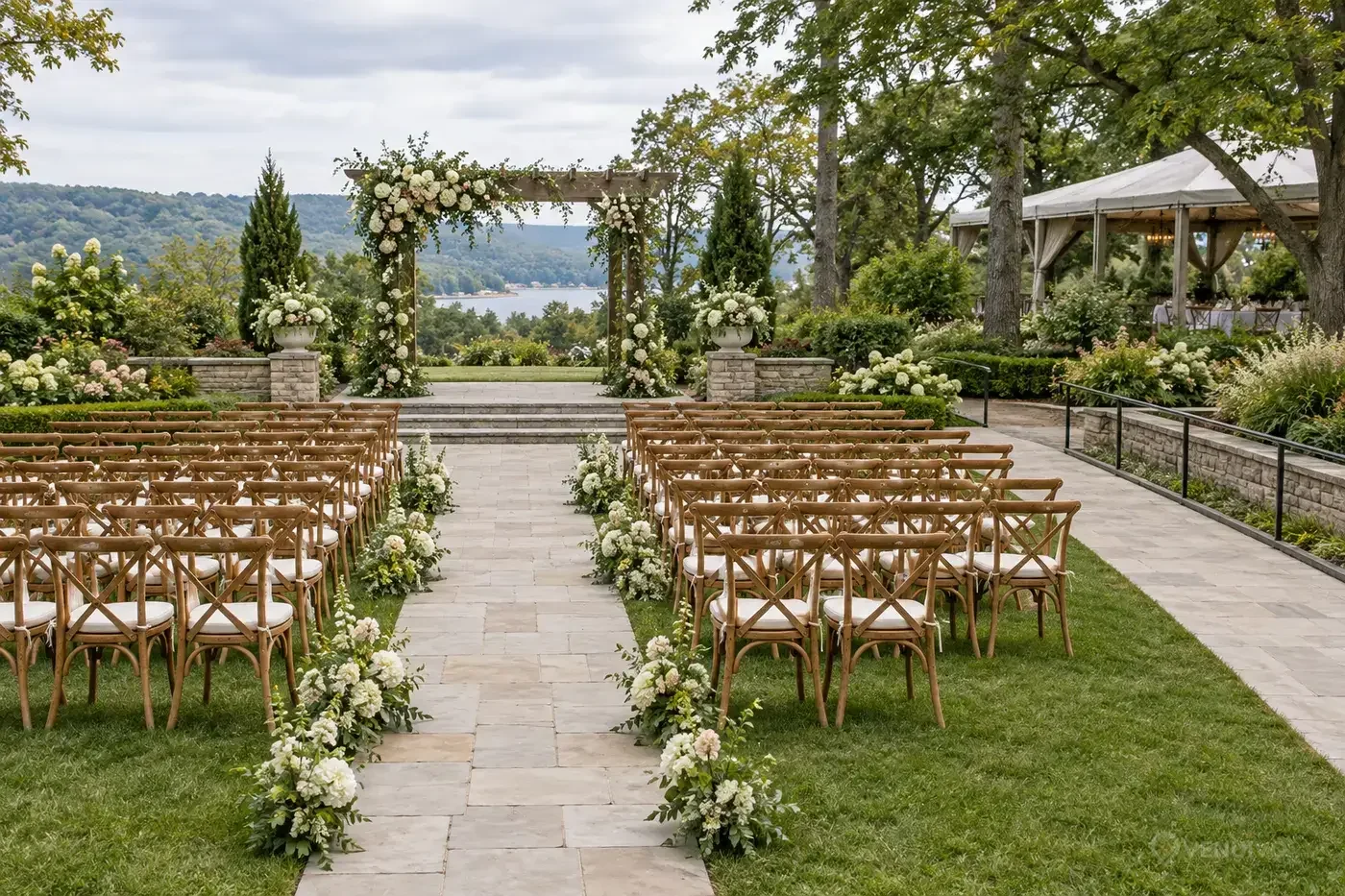
Visit the location at the approximate time of the ceremony. Look at the path of the sun, the surrounding noise, the electrical outlets, the access routes and the distance between the entrance and the arch. A beautiful view is not enough if guests are squinting, the wind is drowning out voices, or the aisle is impassable.
Leave a stable circulation for people with reduced mobility, pushchairs and vendors. Reserve useful seats without isolating the people concerned. Arrange the arch or ceremonial background so that you don't have to constantly cross the aisle for the photographer and videographer. To search for a suitable framework, you can consult the VENUIVO directory of venues and wedding professionals and compare your constraints with our guide on the right time to book your wedding venue.
Sound, music and microphones
Even with few guests, a microphone can be indispensable outdoors. The wind, the distant conversations and the sounds of the place absorb the voices. Test the system with the people who will actually be talking, and plan for backup batteries, cable, or microphone depending on the installation.
Prepare a cue sheet with the exact name of each song, the starting point, the volume and the end signal. Download the necessary files to an offline-available device rather than relying solely on the network. If a DJ or musicians are involved, indicate who gives each start. The guide VENUIVO on the Wedding Playlist can help you distinguish entrances, transitions, the symbolic signing and the exit.
Building a real weather plan B
A plan B is not a tarpaulin found at the last moment. It must offer sufficient space, good visibility, safe ground, a protected power supply and an entrance without crossing the rain. Also check the heat, cold, shade and wind: the problem is not always the shower.
Set a decision time and a person with the authority to move the ceremony. All vendors should know this rule. If the fallback installation changes the arrangement of the chairs or the light, let the photographer know. Our guide to Choose and prepare the photos with the photographer details the information to share in advance.
Coordinate the ceremony with the rest of the day
Place the ceremony in the general schedule taking into account the routes, guest comfort, the photos and the opening of the cocktail. Indicate a realistic arrival time for the speakers and plan for someone who can greet them without interrupting the couple.
After the conclusion, clearly announce the next steps: group photo, cocktail, shuttle or change of space. If some people need to be gathered quickly, prepare a short list and coordinate it with the Seating plan and guest management. The photographer and the videographer must share their main positions; this will prevent a professional from masking the other or asking to replay a scene. For the video, see also the guide on The Wedding Film.
Preparation checklist
Two to three months before
- confirm the officiant and the common thread;
- choose the speakers and assign them an angle;
- validate the main location and plan B;
- define the needs for sound reinforcement, furniture and electricity;
- select the music and the possible ritual.
Three to four weeks before
- gather the speeches and reread the transitions;
- finalize the vows and prepare a backup copy;
- send the running order to the relevant service providers;
- confirm accessibility and reserved seats;
- test the ritual material.
Wedding Week
- do a short rehearsal with the officiant;
- download music offline;
- charge devices and gather the cables, batteries and adapters;
- confirm the weather decision time;
- give the final script to the person in charge.
FAQs about the secular wedding ceremony
Does a secular ceremony have legal value?
Not in France: it is symbolic. The legally recognized marriage is celebrated by the civil registrar. Check the applicable rules if the celebration takes place in another country.
Who can officiate a secular ceremony?
A loved one, several relatives or a professional can conduct the symbolic ceremony. Above all, choose someone who is available to prepare, coordinate the interventions and speak clearly in front of the guests.
How many speeches should be planned?
There is no ideal number. It is better to have a few complementary, well-prepared and audible contributions than a long succession. Assign an angle to each one and test the whole thing out loud.
Should the vows remain secret?
It's a couple's choice. You can discover the texts on the same day while agreeing on a common length and tone. You can also keep a private part and say a shorter version in front of the guests.
Is it mandatory to plan a ritual?
No. The vows and words of loved ones may be enough. Add a ritual only if it expresses something specific and if its performance remains simple in the chosen place.
How do you prevent a ceremony from being too long?
Time texts out loud, eliminate repetitions, limit technical transitions, and have one person manage the running order. The clarity of the narrative matters more than the number of sequences.
What to expect in case of rain or wind?
A genuinely suitable backup space, a decision made at a defined time, a protected sound system and safe circulation. Inform the venue in advance, the officiant, the decoration, the photographer, the videographer and the music control room.
In summary
A personal secular ceremony doesn't have to be complicated. Define your intention, choose an officiant who can keep the story flowing, give an angle to loved ones, write concrete vows and secure the sound, movement and weather. The result will be smoother, more sincere and more comfortable for everyone.