

A successful cocktail reception consists of four decisions: a clear duration, a fluid venue, a truly inclusive beverage offer and a buffet sized by the caterer based on the number of confirmed guests. It is not a "small meal" improvised between the ceremony and dinner, but a time of welcome in its own right. In practice, plan a visible beginning and end, several service points, seats, a weather plan and a person in charge of launching the rest of the program.
This guide helps you organize this moment without queues, waste or delays. It is suitable for a cocktail party at the reception venue as well as a separate cocktail reception, with a larger guest list than the dinner.
What is a wedding drinks reception for?
The drinks reception links the ceremony to the main reception. It allows you to congratulate the bride and groom, meet up with loved ones, offer a first drink and a few bites, then let the dinner guests continue to the next part of the day. When some people are only invited at this time, the organization must be particularly clear and delicate: precise schedules on invitations, simple access, sincere thanks and no awkward announcements at the time of separation.
Before you book anything, define its main function. Is it a question of welcoming everyone after a civil ceremony? To make people wait during the photos? To offer a real cocktail reception? Or to open the evening before a sit-down meal? The answer determines the duration, volume of catering, furniture and rhythm of service.

How long should I expect?
For most weddings, a 2-3 hour window allows time to greet guests, serve the first drinks, take a few photos, and serve several rounds of canapés without stretching the wait. A shorter duration requires a very smooth service. A longer duration is similar to a cocktail reception and requires more seating, food and light entertainment.
| Format | Time marker | Point of vigilance |
|---|---|---|
| Simple reception after the ceremony | Approximately 1 hour 30 minutes to 2 hours | Limit travel and open several points of service |
| Classic drinks reception | Approximately 2 to 3 hours | Plan a clear flow and enough seating |
| Standing dinner reception | 3 hours or more | Adjust quantities, substantial food and comfort |
These durations are benchmarks, not obligations. Adjust them to the time of the ceremony, the route, the season, the photos, the age of the guests and the size of the meal. If you're hosting a dinner party afterwards, set a realistic table time and communicate it to the caterer, photographer, DJ and venue manager.
Building a simple process
- Opening: water and soft drinks available upon arrival, followed by other drinks.
- Welcome: the bride and groom greet the guests without getting stuck in a single area.
- Build the rhythm: serve bites regularly and open the buffet gradually.
- Highlight: short speech, group photo or planned activity, without interrupting the entire service.
- Transition: clear announcement of the next step and support for the guests concerned.
Choose a fluid, comfortable and accessible place
The best space is not necessarily the most spectacular. It must absorb arrivals, allow staff to circulate and offer a fallback solution. During the wedding-venue visit, observe the accesses, the distance from the parking lot, the shade, the toilets, the end-of-day lighting and the path to dinner.
Spread out the uses instead of concentrating all the guests around a single buffet: a reception area, several drink points, poseur tables, proper chairs and a quiet space. Elderly, pregnant or tired people should be able to sit without leaving the group. Also check the thresholds, slopes, passage widths and rolling surfaces for people with reduced mobility.
The weather plan is not optional
A garden is only a solid plan A if plan B is already installed or can be quickly mobilized. Ask the venue what covered capacity is actually available, who decides on the switchover, at what time and with which team. In case of heat, provide shade, fresh water and appropriate food storage. In case of rain, protect the path between the parking lot, the cocktail party and the toilets.
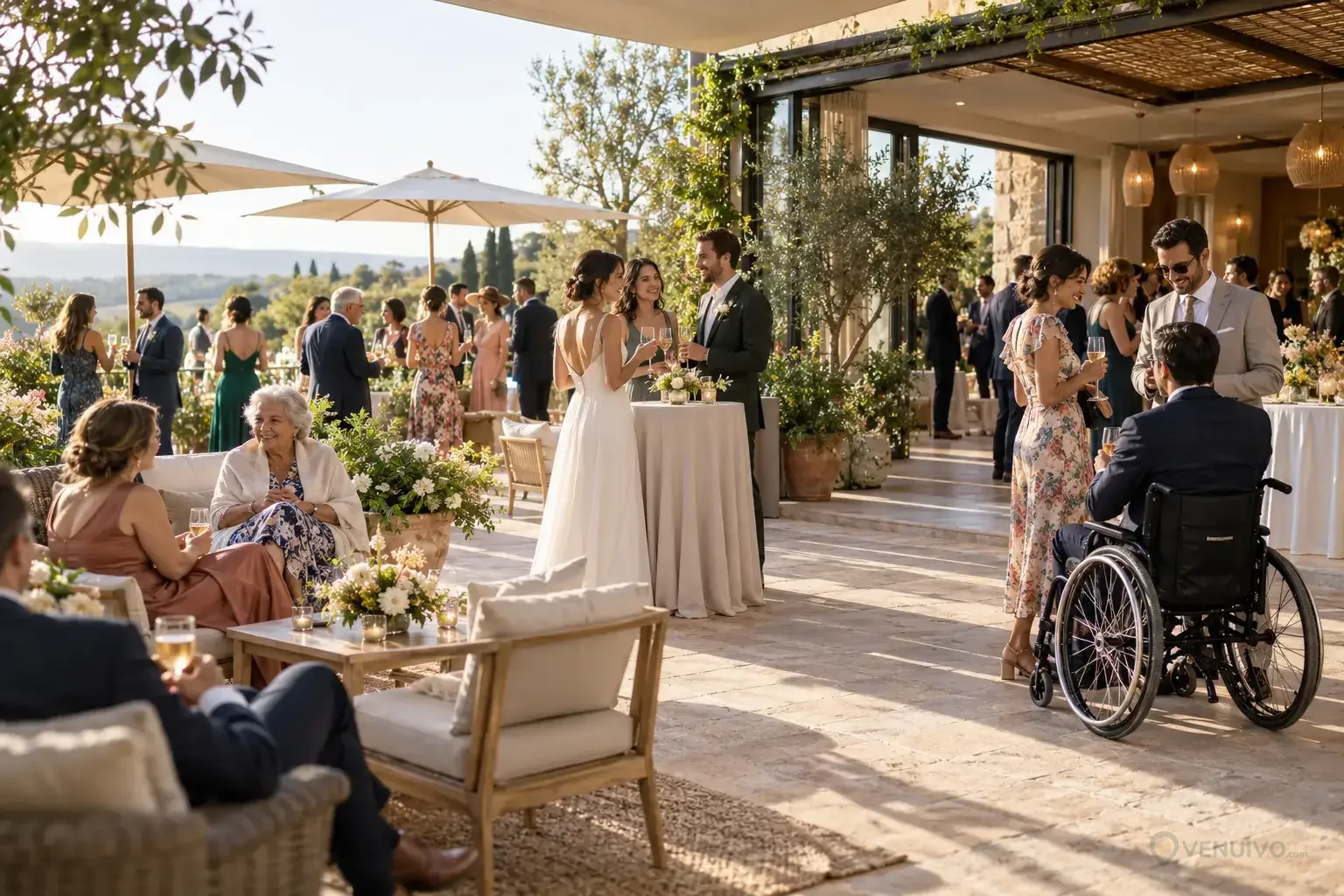
Drinks: offering choice without trivializing alcohol-free
Start with water: still and sparkling, visible, easy to reach and regularly renewed. Then add elaborate non-alcoholic drinks — chilled infusion, low-sugar lemonade, juice, flavored water or non-alcoholic cocktail — and then the alcoholic offer decided with the caterer. Alcohol-free should not be relegated to a secondary table: serve it in a presentation that is as neat as other drinks.
Don't calculate quantities with a universal rule. Ask the caterer or wine merchant to draw up a proposal based on the number of adults and children, the duration, the temperature, the time, the meal that follows, the habits of the group and the number of points of service. Ask what unopened stock can be returned, and confirm storage, ice, glassware, staffing and any corkage fee.
Alcohol: integrating safety into the process
In France, the general driving limit is 0.5 g of alcohol per litre of blood, and 0.2 g/L, particularly for drivers on probation. The safest solution is not to drink while driving. Appoint sober drivers, plan for a shuttle or transport solutions, leave water and alcohol-free available until departure, and never push a guest to drink. The principle of the designated "Sam" driver is also recommended by the French road-safety authority.
Official sources consulted on 24 October 2026: Service-Public.fr — Drinking and driving and Road safety — tips for novice drivers.
Buffet: build a clear, sufficient offer
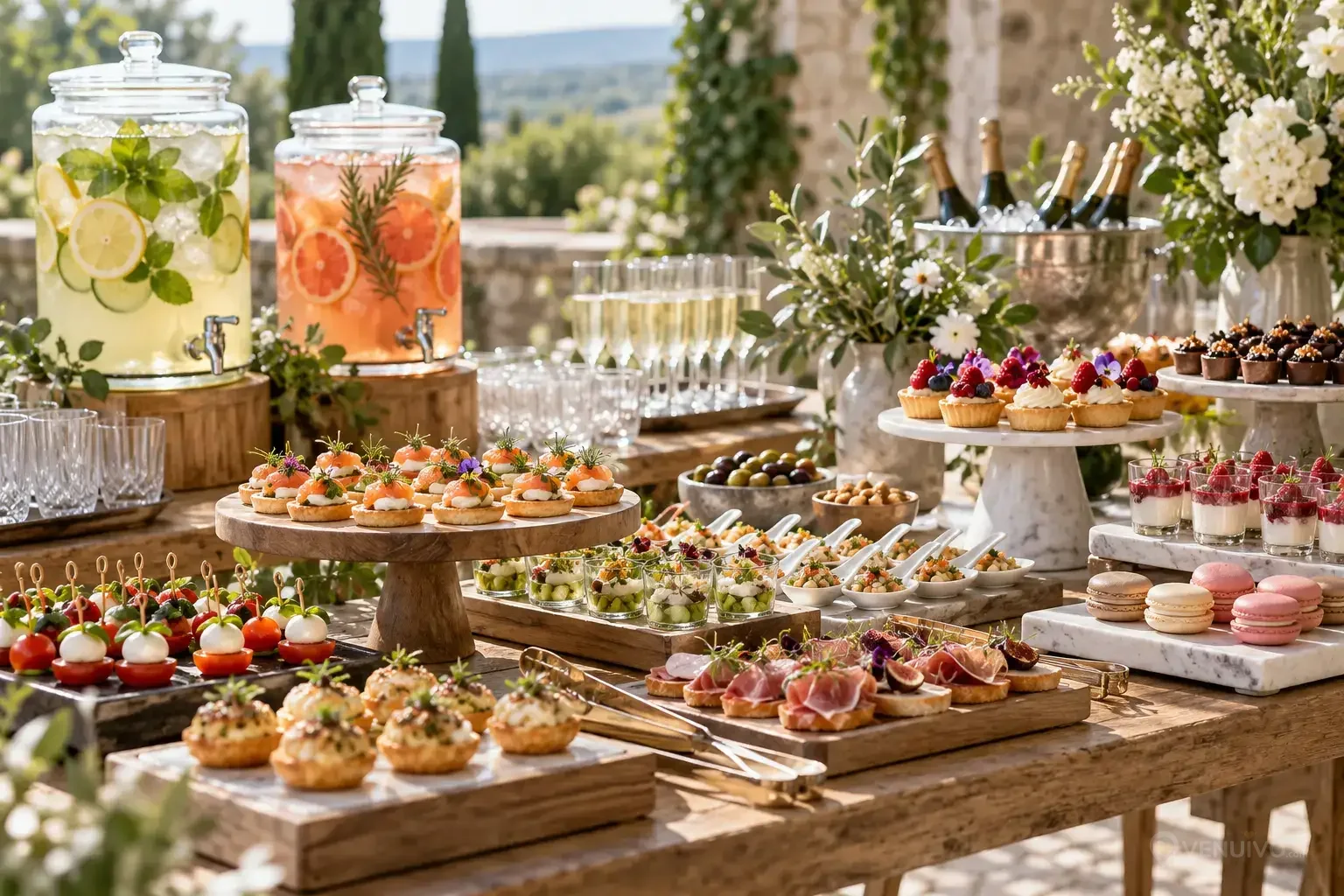
A well-designed buffet is easy to understand at a glance. Separate families of bites, avoid dishes that are difficult to eat standing up, and alternate textures. Ask the caterer for a progression: fresh items at the start, hot bites served at the right time, then a sweet note if it doesn't compete with the dinner dessert.
| Element | Question to ask the caterer | Decision to be validated |
|---|---|---|
| Variety | What options are vegetarian, alcohol-free and suitable for children? | A visible offer for every profile |
| Allergens | How is the information provided and updated? | Clear labels or staff able to answer |
| Service | How many service points and staff members are needed to prevent queues? | A traffic and restocking plan |
| Temperature | How are cold and hot products stored? | Equipment, serving times and removal |
| End of service | What happens to leftovers and closed bottles? | Written conditions and health compliance |
In France, allergen information must be accessible for non-prepackaged foodstuffs. Have the professional confirm the method chosen and avoid improvised labels that could become false after a change in recipe. For food safety, limit the time spent at room temperature and follow the caterer's instructions; ANSES reminds us of the importance of not interrupting the cold chain.
Official sources consulted on 24 October 2026: DGCCRF — rules on the labelling of foodstuffs and ANSES — cold chain.
Budget: compare complete quotes
The price per person is not enough to compare two quotes. Check the length of time, number of servers, glassware, furniture, drinks, ice, transportation, set-up, clear-up, table linen, corkage and overtime. A cheaper quote can become more expensive if essential items are billed separately.
Link this expense to your overall wedding budget. To reduce the cost without degrading the welcome, simplify the variety, choose seasonal products and focus the effort on the quality of the service. Significantly reducing staff or adding too many complex food stations often creates more waiting times and technical costs.
Questions to include in the quote
- How long is the service included, from set-up to clear-up?
- What materials, consumables and travel expenses are included?
- How does the price change if the number of guests changes?
- What date sets the final number of guests?
- What are the cancellation, postponement and bad-weather terms?
- Who manages allergens, the cold chain and waste?
To choose the right level of service, also consult our guide to Choosing your wedding caterer.
Invitations and transition to dinner
If not all guests attend the dinner, prepare two separate versions of the invitation wording. Indicate the address, hours and nature of the invitation unambiguously. On site, avoid asking the people concerned to leave in front of everyone. Thank them individually when possible and organize the transition while a natural cue occurs: moving to another room, taking a group photo, or changing spaces.
For the guests who stay, avoid downtime. The dining room manager or DJ can announce the opening of the dinner while the teams finish tidying up. If the meal is long, keep the drinks reception light enough to preserve guests’ appetites. If, on the other hand, you opt for a cocktail reception, design it as such, with more substantial food and enough seating.
Wedding drinks reception checklist
- Define the exact function, guests and schedules.
- Confirm location, capacity, accessibility and weather plan.
- Have the quantities validated by the caterer according to the real context.
- Provide water and soft drinks at the same level of quality.
- Check allergens, cold, hot, restocking and end of service.
- Divide drinks, buffet, seating and quiet areas.
- Coordinate catering, venue, photographer, DJ and transportation.
- Designate a person responsible for timing and transition.
- Anticipate returns with sober drivers, shuttle or accommodation.
- Review the quotes, insurance and cancellation terms.
Frequently asked questions
Should everyone be invited to dinner?
No, but the difference in invitation must be clearly and respectfully announced from the start. Plan for separate cards or messages and an elegant end of the reception, without singling anyone out publicly.
How many drinks and canapés should I provide?
There is no reliable quantity independent of context. Ask the caterer for a written calculation based on the number of guests, the duration, the weather, the time, the meal that follows and the profile of the guests. Also compare the terms for returning unopened stock and for restocking.
Can the reception be held at another venue?
Yes, provided that you account for travel time, parking, accessibility, equipment transfers and the risk of delay. When the ceremony and dinner are far away, an intermediate location can complicate the logistics.
What should you provide for children?
Easily identifiable drinks, simple bites, seating and a quiet area under the supervision of their responsible adults. Keep hot equipment, fragile glass and alcohol away from high-traffic areas.
Can the reception replace the meal?
Yes, if it becomes a true standing dinner reception: duration, variety, quantity, rhythm of service and seats must then be designed as a complete meal. Have this format priced explicitly.
In summary
A good wedding drinks reception does not need a long list of food stations. Above all, it must welcome without waiting, offer choices for all, protect food, make movement easy and lead naturally into the next part of the day. A clear duration, a ready weather plan, a briefed caterer, and a respectful transition do more for the guest experience than an overcrowded décor. After the reception, if you are extending the reunion, prepare your Brunch the day after the wedding so that each moment keeps its own rhythm.