

An effective wedding invitation immediately gives your guests the information they need, sets a realistic response deadline, and avoids scattered exchanges. Start by stabilizing the date, the places and the list of people invited. You can then choose the format, write a text that is consistent with your wedding and organize the follow-up of the answers in a single table.
The most beautiful model does not compensate for a forgotten time, an ambiguous address or an answer that is impossible to transmit. This guide helps you build a clear, elegant and practical announcement, from the first draft to reminders.
When to send wedding invitations?
The right schedule depends mainly on the distance, the period and the complexity of the weekend. A local wedding with a majority of close guests requires less anticipation than a summer reception, a wedding abroad or a multi-day event.
| Step | Practical marker | Objective |
|---|---|---|
| Notify distant guests | 8 to 12 months before if necessary | Allow them to plan transport and accommodation |
| Validate content | 6 to 8 months before | Confirm hours, addresses and response methods |
| Send the announcement | 4 to 6 months before | Leave time to get organized without sending too early |
| Close responses | 6 to 10 weeks before | Finalize meals, tables, shuttles and service providers |
| Follow up with non-respondents | 2 to 3 weeks before closing | Avoiding a last-minute emergency |
These deadlines are organizational benchmarks, not obligations. Adjust them to the date your caterer, venue, or host requires a final number. For a wedding in high season, a "save the date" can be useful before the full invitation. It announces the date, but does not replace the detailed invitation.
What should a wedding invitation contain?
Essential information
Reread your text as if you were discovering the event. A guest must be able to identify without hesitation:
- the first names of the bride and groom;
- the full date of the wedding;
- which events each person is invited to;
- the time and precise address of the ceremony;
- the time and address of the reception;
- the deadline and how to respond;
- a contact in case of questions.
If the civil ceremony and reception are not on the same day, write each date out in full and clearly separate the two appointments. Our guide to civil wedding at the town hall can help you check how this part of the day is flowing.
Information to add according to your organization
Add only what really helps guests: dress code, parking, shuttle, accommodations, next-day brunch, access constraints, wedding website, or gift list. If the details are plentiful, keep the master card very legible and place the practical information on a separate insert or online page.
An invitation does not automatically imply all the moments of the wedding. If some guests are invited to the cocktail but not to dinner, prepare separate versions. Vague wording creates misunderstandings that are difficult to correct.

How to write the invitation text?
The tone must resemble the couple and remain understandable. A sleek layout doesn't require complicated sentences. Prefer a short structure: announcement, date, location, invitation, response.
Classic and warm example
Camille and Jordan are delighted to invite you to celebrate their wedding on Saturday, June 12, 2027. The ceremony will take place at 15 h at [town hall], then we will gather from 17 h at [venue name]. Please confirm your attendance by April 15.
Example for a ceremony and a reception at two venues
We would be delighted to have you with us for our ceremony at 14 h 30 at [full address]. The reception will continue from 17 h 30 at [venue name and address]. Group transport between the two locations is available by reservation.
Example for a wedding weekend
Join us for a weekend of celebration from Friday, May 21 to Sunday, May 23. Your personal invitation specifies the times to which you are invited. The program, accommodations and the response form are available on our wedding website.
Avoid formulas that assume a certain presence. "Thank you for responding" is clearer than "we are counting on you". For children or accompanying persons, indicate precisely the persons invited on the envelope and, if necessary, in the response form.
Paper, digital or hybrid invitations: what to choose?
| Format | Advantages | Points of vigilance |
|---|---|---|
| Paper | Keepsake, polished finish, accessible without digital tools | Printing, addressing, postage and postal returns |
| Digital | Fast sending, direct links, simple corrections | Junk messages, outdated addresses, variable presentation |
| Hybrid | Emotion of paper and convenient online tracking | You have to keep the information consistent on both media |
The hybrid format is suitable for many couples: a paper card announces the wedding, while a QR code or a short address leads to evolving information. However, do not make a phone essential to know the main address and time. Guests who are not very comfortable with digital technology should be able to answer by phone or mail.
Build the mailing list without leaving anyone behind
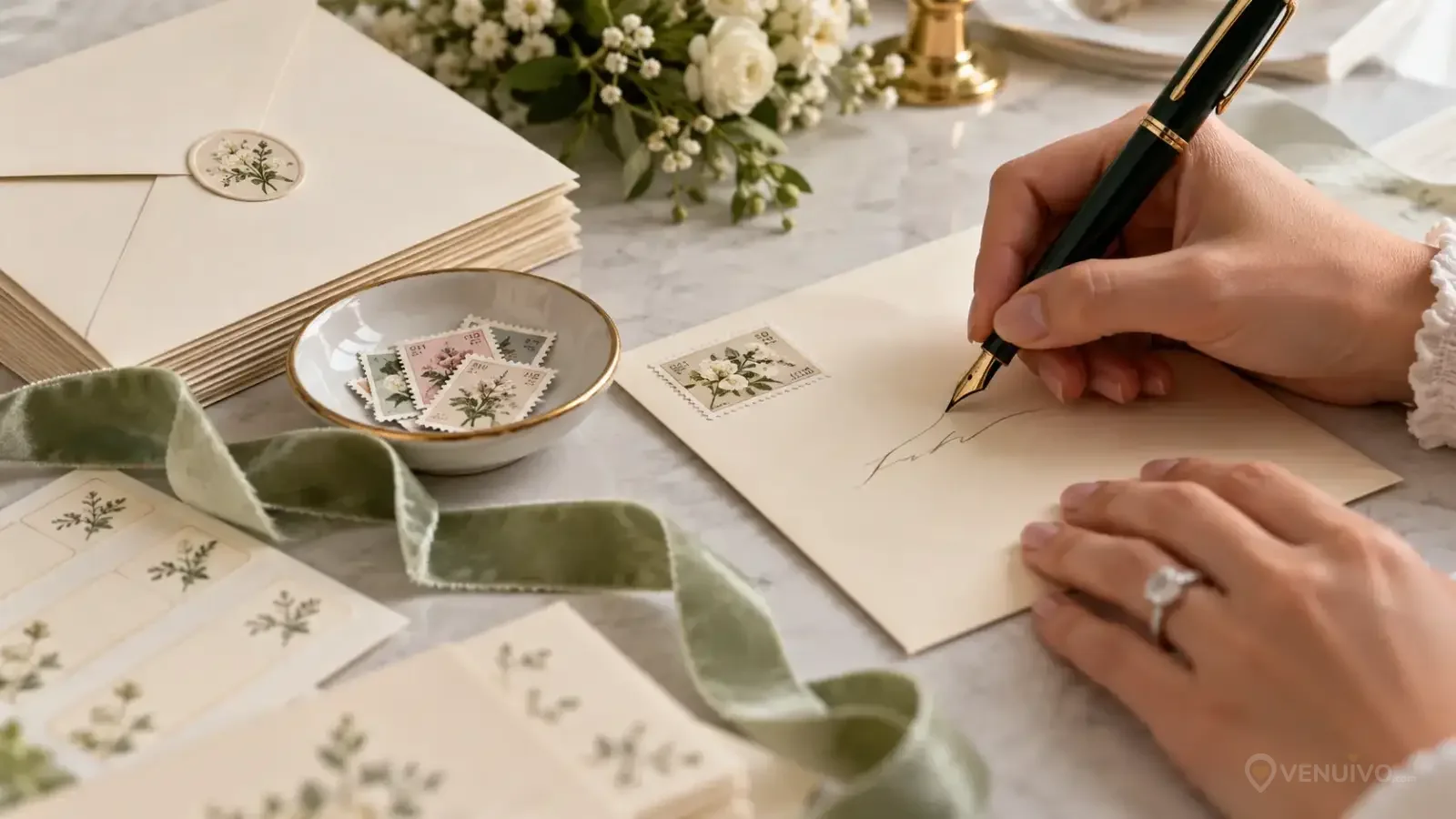
The list of invitations should start from your guest list, not your address book. Create one row per household and specify who is actually invited. The useful columns are: household name, adults, children, mailing address, email, telephone, relevant events, date sent, response, dietary requirements, transportation and comments.
Before printing, check for duplicates, separated couples, children who are now adults, and changes of address. Have the list proofread by one person from each family, then freeze a dated version. This base will then be used for the Seating Plan and avoid re-entering the same information.
To reduce the risk of a postal return, use the official address provided by the guest. In particular, La Poste recommends a legible address block, aligned to the left and without unnecessary punctuation; bpost and Swiss Post also publish their own addressing guidelines. Rules may vary depending on the country of destination.
Organize RSVP responses without getting lost
Asking the right questions
A good response form doesn't just ask "present or absent." It collects the information necessary for your decisions:
- presence of each person invited by name;
- participation in the ceremony, dinner and brunch;
- choice of menu when requested by the caterer;
- allergies or relevant dietary needs;
- need for a shuttle bus or adapted parking space;
- need accommodation or estimated time of arrival.
Don't collect information "just in case." Each question must serve a specific action. For transport, indicate the known times and refer to our guide dedicated to the Wedding Shuttle.
Centralize all responses
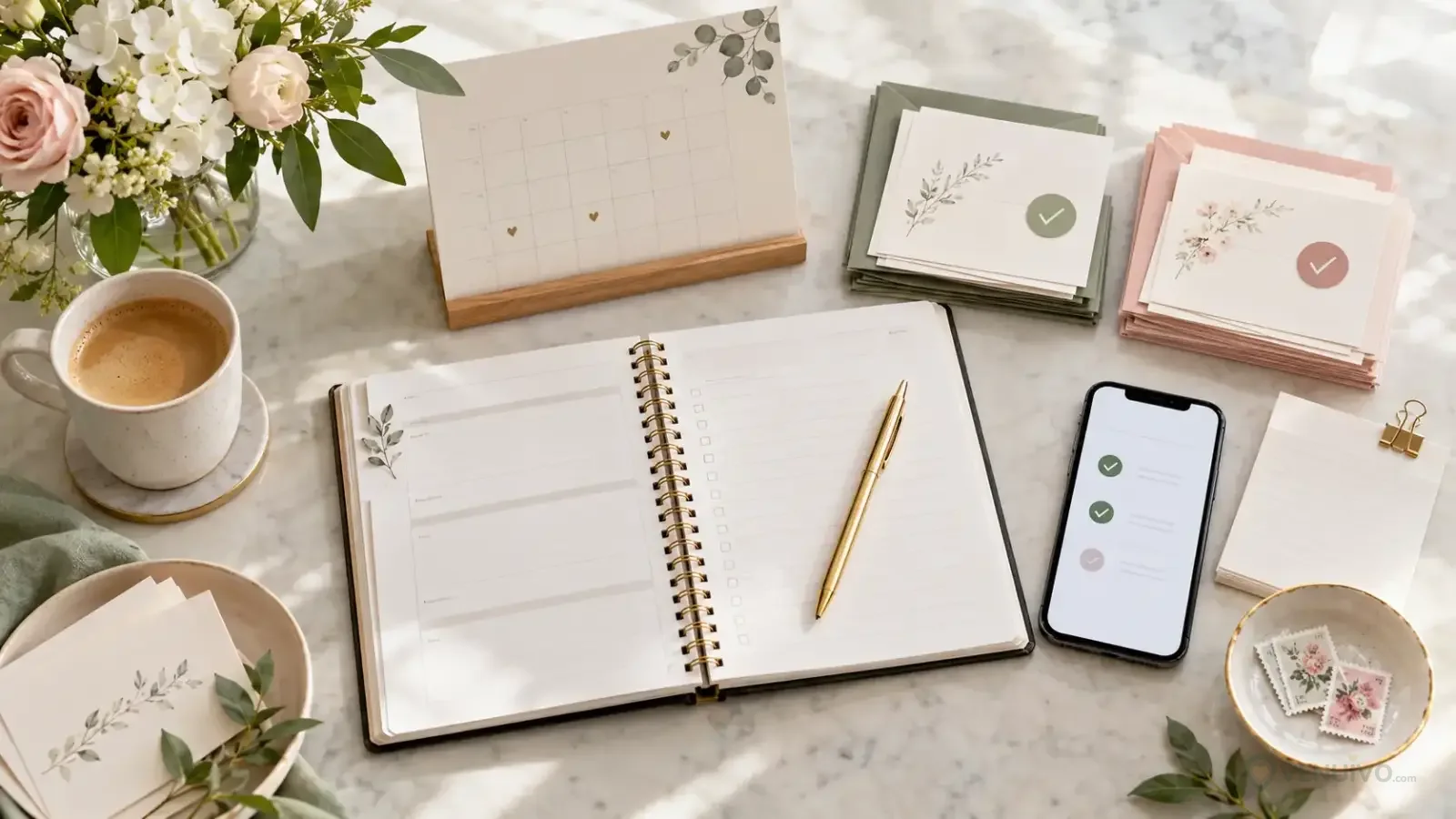
Choose a single source of truth: spreadsheet, guest management tool, or your wedding website module. A response received by telephone must be entered immediately in the same place as an online response. Add the date and name of the person who submitted the information.
Use four simple statuses: to invite, sent, replied, follow-up needed. Avoid confusing "message read" with "presence confirmed". Confirmation is not complete until all members of the household have responded and the relevant choices are provided.
The most common mistakes to avoid
- Sending before confirming locations: A printed temporary address becomes difficult to correct.
- Forgetting the year or day of the week: write the full date.
- Mix invitation and general information: guests must know exactly which events they are invited to.
- Fix a response too late: keep a margin before the caterer's and venue's deadlines.
- Using too many channels: responses spread across messages, calls and social networks get lost.
- Print without a test copy: check the font size, contrast, accents, QR code and legibility of the address.
- Forget the sender: A return address makes it easier to process undelivered mail.
Adapt the invitation to international guests
For guests who do not speak French, prepare a version in their language or at least a full English version. Don't translate proper names, but explain the types of places and stages of the program. Write the schedules in 24-hour format and add the country in each address.
A multilingual wedding website can include maps, accommodations, transportation and contacts. Check every link from a phone, without a connected account. If you use a QR code, you should also print the web address in plain text: a damaged code or an old camera should not block access.
Checklist before printing and mailing
- Compare the mailing list to the validated guest list.
- Check date, year, hours, names and addresses on a reliable source.
- Confirm that each version corresponds to the events actually offered.
- Test the RSVP form, the website and the QR code on mobile.
- Have the text proofread by two people who did not write it.
- Order or print a test copy before the complete series.
- Weigh the final envelope with all its boxes before postage.
- Photograph or archive the final version and its date of sending.
- Prepare the follow-up table and the reminder schedule.
Incorporate these steps into your General planning of the wedding. To control printing, stationery and postage expenses, add a dedicated line to your Wedding budget rather than dispersing them across multiple posts.
Wedding Invitations FAQs
Should you send a "save the date" and an invitation?
Not always. The "save the date" is useful if your guests need to book transport, accommodation or time off early. The complete invitation is still necessary when the places, times and methods of response are confirmed.
Can I send only a digital invitation?
Yes, if all your guests can receive and view it easily. Plan a paper or telephone solution for people who are less connected and check that the message does not arrive in the spam folder.
How do I indicate that children are not invited?
Specifically name the adults invited on the envelope and in the form. If an explanation is necessary, formulate it in a caring and consistent way, for example by specifying that the reception is organized only for adults.
How do I invite a person with a companion?
Write their name followed by "and the person of your choice", then provide a field to find out the identity of the accompanying person. If the invitation is nominative, avoid a formula that would suggest that an additional guest is automatically included.
What if a guest doesn't respond?
Send a short reminder before the deadline, then call if necessary. Give a firm date and explain that the final number must be communicated to the service providers. If you don't get a response after this deadline, do not count the guest as attending.
How many additional copies should I provide?
Allow a small margin for address errors, additions agreed together and a few keepsakes. The number depends on your list and the printing method; However, avoid using this margin to expand the list without checking capacity and budget.
Useful sources for postal addressing
- La Poste — how to write an address correctly
- bpost — Write a postal address correctly
- Swiss Post — correct addressing of consignments
A clear announcement simplifies the rest of the process
The invitation is both an announcement and an organizational tool. By bringing together a precise text, an invitation adapted to each household and a centralized follow-up, you make life easier for your guests and your service providers. Take the time to test a full version before printing: a few minutes of checking can avoid dozens of clarification messages.