
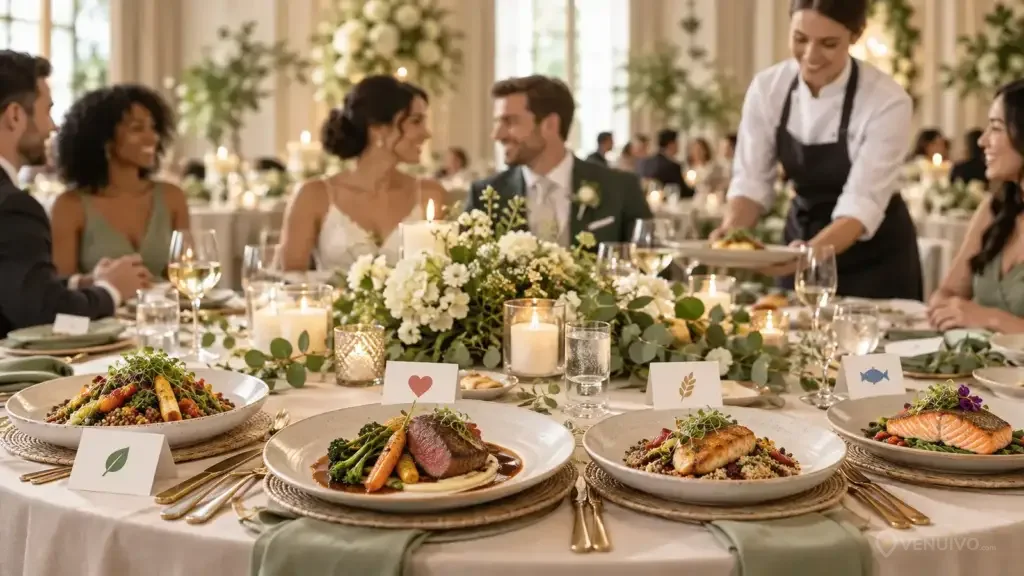
To manage allergies, vegetarian diets and other special menus at a wedding, you need to centralize needs, have them confirmed by the caterer, identify each plate and plan a service protocol. The right reflex is not to multiply the options at the last minute, but to build a reliable information channel: guest, couple, caterer, room manager and waiter.
A food allergy is not a preference and is not treated as a simple "no such ingredient". The consequences can be serious, and sometimes cross-contamination is enough to trigger a reaction. Conversely, a vegetarian, vegan, religious or preference-based choice must also be respected, without being presented as a medical guarantee. This distinction helps the caterer assign the right procedures, the right preparation time, and the right level of vigilance.
This guide offers a concrete method, from the Response form sent with the invitation until the plates are served. It completes the advice for Choosing your wedding caterer and allows the subject to be addressed without stigmatizing the guests concerned.
Start by identifying needs
A list entitled "special dietary requirements" is too vague. It puts in the same column a diagnosed allergy, an intolerance, a religious practice, a vegetarian diet and a simple food that is not appreciated. However, the caterer does not need the same information in each case.
- Food allergy: the guest indicates the allergen concerned, the level of known risk and the instructions communicated by his or her health professional. The couple transmits the information without reformulating it.
- Intolerance or sensitivity: the guest specifies what he should avoid and whether or not traces are a problem for him.
- Celiac disease: it involves strict avoidance of gluten and particular vigilance on cross-contamination; "Wheat-free" and "gluten-free" are not always equivalent.
- Food choice: vegetarian, vegan, pork-free or other practices must be clearly described, without presuming accepted ingredients.
- Preference: It can often be managed by a flexible composition, but should not mask a medical need.
European regulations require information on fourteen categories of allergens that must be declared. In France, this information also applies to non-pre-packaged foodstuffs offered by professionals. This does not mean that all dishes are suitable for all allergies: the caterer must be able to explain the ingredients used and how it is organised. Official references are available from the DGCCRF and in the European Consumer Information Regulation.
Gather information without exposing guests
The RSVP form is the best place to ask a short, neutral, and optional question. Avoid asking for a medical record or circulating the answers in a group chat. The useful data are the name, the table, the need, the ingredients to avoid and a means of contact if clarification is needed.
Sample question: "Do you have an allergy, intolerance, or diet that the caterer needs to know about?" Please indicate the foods concerned and, if necessary, whether traces or cross-contamination pose a risk. »
Add a deadline early enough for the caterer to cost and test the variations. Then follow up on ambiguous answers individually: "lactose-free", "dairy-free" and "allergy to milk proteins" do not refer to the same situation. The couple should not make a medical interpretation; they pass the guest’s exact words to the professional.
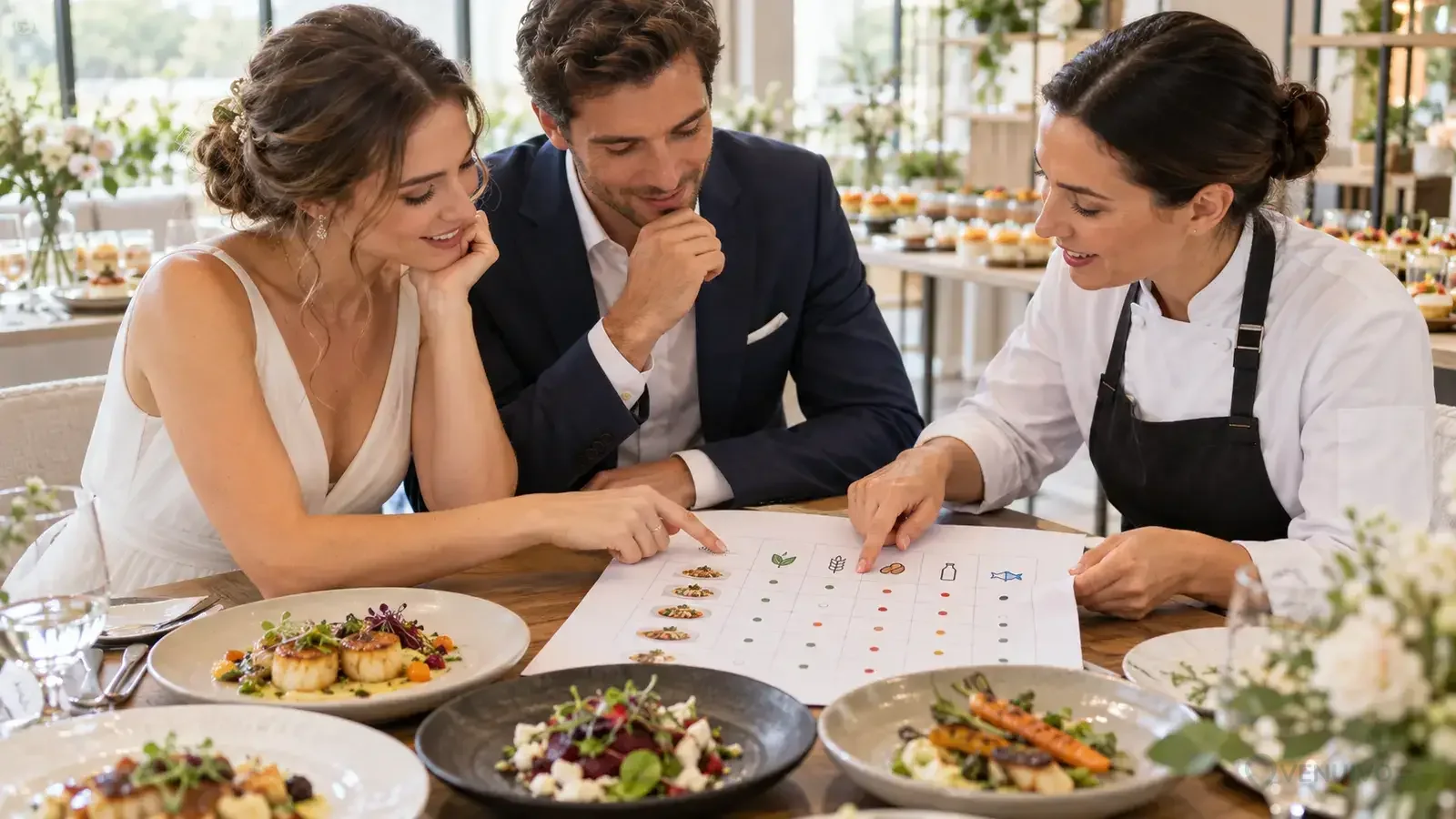
The right follow-up table to share at the right time
| Field | Useful example | What to avoid |
|---|---|---|
| Guest and table | Camille D., table 6 | "A person at the table of friends" |
| Type of requirement | Allergy declared / vegetarian / pork free | Group everything under "special" |
| Affected food | Peanut; milk; egg; gluten | "Picky eater" |
| Risk of traces | Yes, depending on the guest / not specified | Assume that traces are accepted |
| Validated menu | Starter B, main course V2, dessert D3 | A free-form note without a plate code |
| On-site contact | Front-of-house manager + designated witness | Ask the couple to troubleshoot during service |
The complete document remains between the couple, the caterer and the people who really need it. The seating plan used by all guests can be satisfied with a discreet code. To avoid last-minute mistakes, lock the final version at the same time as your Wedding Seating Plan.
Choosing a caterer who can explain their protocol
The decisive question is not "Can you make an allergen-free dish?", but "How do you identify ingredients, avoid cross-contact and hand the right plate to the right person?" A precise answer is more reassuring than a general promise.
In particular, ask for:
- whether the technical data sheets and labels of the products are kept and can be consulted;
- how frying utensils, surfaces, containers and baths are separated;
- when special menus are prepared and plated;
- how plates are spotted without error or public exposure;
- who carries out the final control in the kitchen and who hands the dish over in the dining room;
- how a change of ingredient, supplier or recipe is managed;
- what the professional can genuinely guarantee in their kitchen.
The word "guaranteed" should be used with caution. A recipe without peanuts in its list of ingredients is not necessarily suitable for an allergic person if the kitchen does not control the risk of traces. When the caterer cannot guarantee a requested level of security, he must say so before signing. The couple can then look for an alternative prepared and packaged by a specialized professional, provided that the venue and the caterer accept its storage and service.
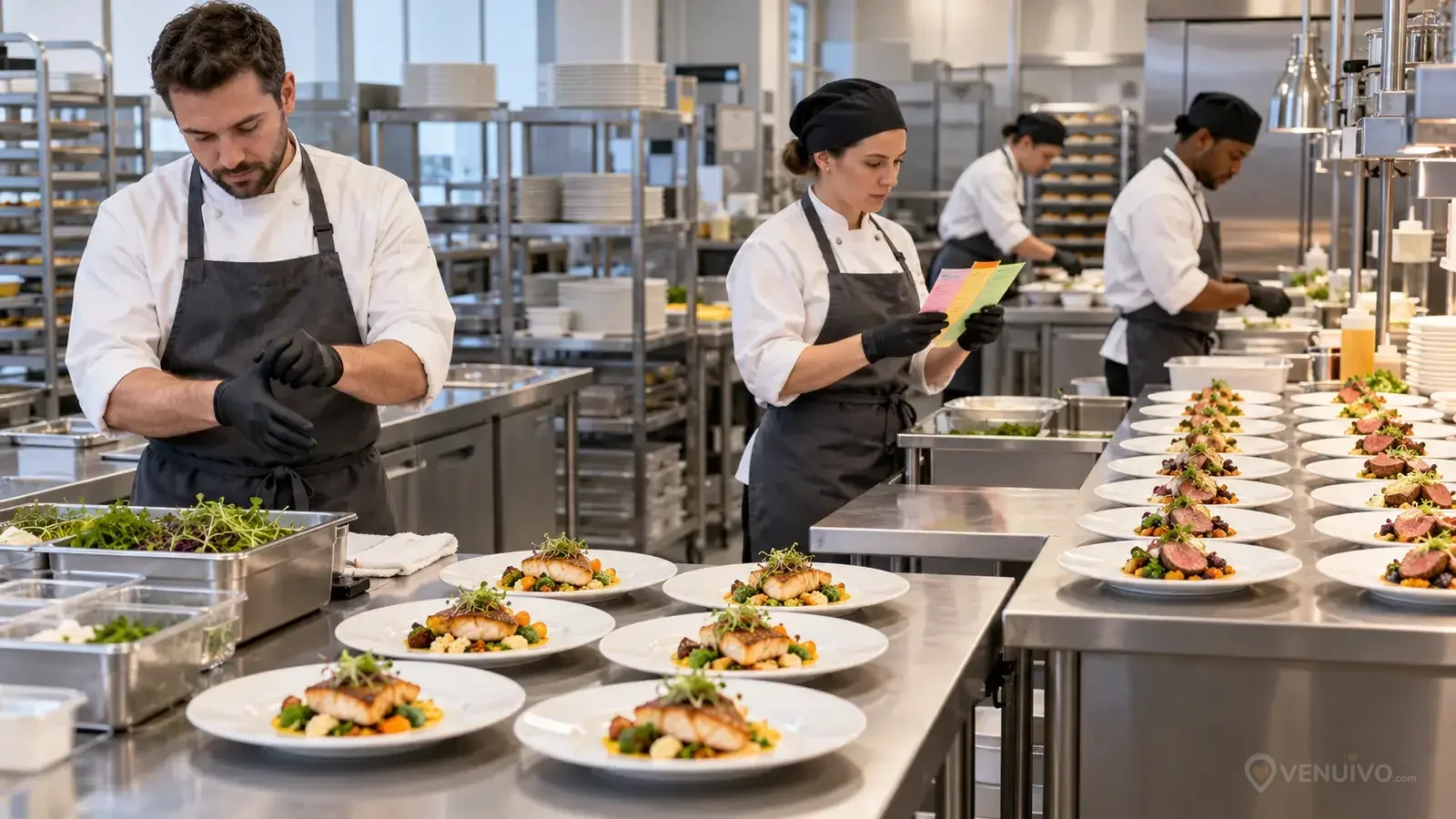
Designing fewer variants, but real plates
A special menu shouldn't be an impoverished plate. Removing the sauce, cheese, and topping from a standard dish can leave a meal unbalanced and frustrating. It is better to design one or two alternative bases that are really successful, and then check whether they cover several compatible needs.
A well-thought-out plant-based option
A plant-based plate can combine seasonal vegetables, legumes or cereals, a well-crafted sauce and a crispy element. It should have a real main course, not just the sides of the other guests. Check separately whether broths, gelling agents, sauces, cheeses and desserts are vegetarian or vegan.
Gluten-free requires specific questions
A naturally gluten-free formula can be contaminated by a board, a colander, a suspended flour or a shared fryer. The DGCCRF reminds that the "gluten-free" mentions meet specific rules. For a guest with celiac disease, let the caterer and guest clarify the level of proficiency required; Don't assume that a recipe is safe because it doesn't contain visible wheat.
The children's menus remain in the same circuit
Children can also have an allergy. Their meal must appear in the table, with the same marking as that of the adults. A simple dish may be more suited to their pace, but it should never be distributed randomly because several plates look the same.
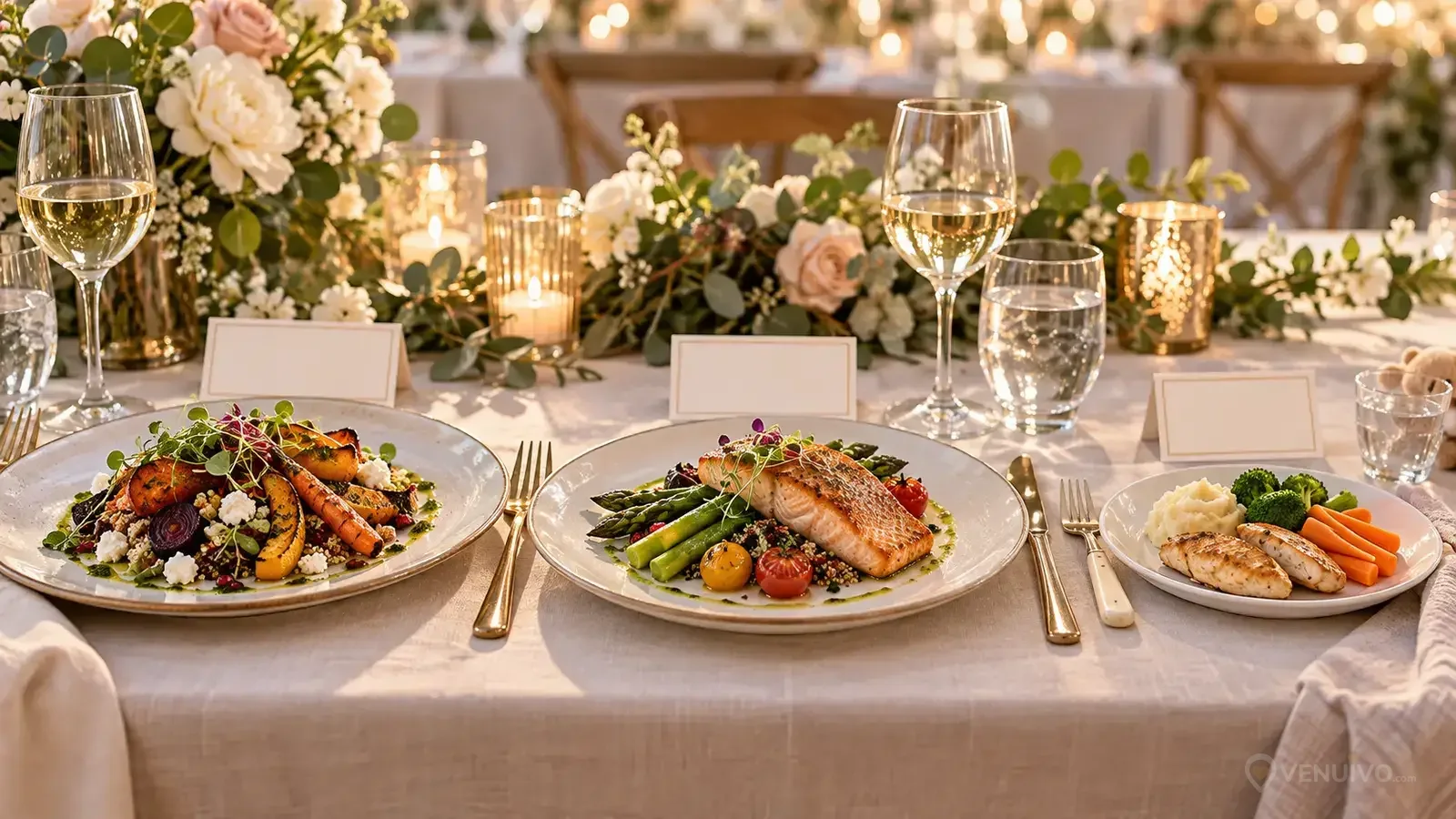
Organizing service from the drinks reception to dessert
Cocktail receptions and buffets require special vigilance: guests help themselves, tongs change trays and labels can be moved. For the Reception, ask for a tray reserved, identified and given directly to the person concerned when the caterer recommends it. A label alone does not control cross-contamination.
At dinner, the protocol must be simple enough to be understood by the whole team, including the reinforcements who arrived the same day. A coded table card, a ticket on each plate and an oral validation by the head waiter constitute three additional checks.
| Timing | Recommended control | Responsible |
|---|---|---|
| Receiving products | Verified labels and substitutions | Chef |
| Implementation | Identified areas, utensils and containers | Kitchen team |
| To serve | Menu, guest code, and table reconciled | Chef or pass |
| Leaving the kitchen | Plate announced and entrusted to a waiter | Room manager |
| Hand-off to the guest | Name confirmed discreetly | Referring server |
| Unforeseen change | Stop, check and validate again | Chef + room manager |
Designate a single point of contact on the wedding side — witness, wedding planner or family member — who knows the final table and can answer without asking the bride and groom. This contact person does not decide whether a dish is safe: he simply connects the team with the right person.
Have a plan in case of doubt or reaction
Before the wedding, the people concerned follow the instructions given by their health professional and keep with them the treatments that have been prescribed to them. The couple asks the place who is alerting the emergency services, what is the precise address to communicate and how the teams access the room. This information can be added to the general event safety file.
If a guest is unsure of their plate, service should stop for that person until checked. Do not remove the visible ingredient or swap a garnish: the dish returns to the kitchen and a new plate is prepared according to the agreed protocol. In case of symptoms, call the emergency services immediately according to local instructions and follow the guest's medical plan. The Anses resources on food allergies remind us of the importance of information and prevention.
Budget: cost the work, not a penalty per guest
Variants can generate a legitimate additional cost: specific ingredients, separate production, individual packaging, additional staff or ordering from a suitable laboratory. Ask for a detailed price from the quote and a threshold at which an alternative recipe becomes more economical than a succession of single dishes.
An effective strategy is often to make the main menu inclusive across multiple items, and then limit overrides. For example, a plant-based starter designed gluten-free can be suitable for more guests — subject to the necessary protocol — without giving the impression of a meal "on the side". However, never choose a common solution at the expense of a safety requirement.
Also think about the Brunch the day after the wedding : leftovers, open buffets and new service providers can break the information chain. Forward the helpful list to the brunch manager again instead of assuming it follows automatically.
Checklist to be validated before the wedding
- Add a clear question about dietary requirements to the RSVP.
- Follow up on vague answers and keep the exact words of the guest.
- Send an initial list to the caterer before tasting.
- Ask what guarantees and limits the caterer can announce.
- Validate recipes, ingredients, substitutions and risks of cross-contact.
- Assign a menu code to each guest and their place.
- Freeze the table after the deadline, then date each update.
- Appoint a point of contact on the wedding side and a manager on the catering side.
- Plan for the same rigor for cocktails, desserts, bars and brunch.
- Check the precise address, the access of the emergency services and the venue’s procedure.
Frequently asked questions
When to ask guests about allergies and diets?
Ask the question as soon as you send the announcement or RSVP form. Send an estimate to the caterer early, then a final list of names after the deadline for response and before the seating plan is finalized.
Can you write "allergen-free" on a wedding menu?
This formula is too general: there are several allergens and risks of traces. Prefer precise information on the ingredients and ask the caterer what he can really guarantee in his production environment.
Is a vegan dish automatically suitable for someone with a milk or egg allergy?
No. A vegan recipe does not normally use these ingredients, but it may have been prepared with shared equipment or contain a product with traces on the label. Only the professional's protocol makes it possible to assess the declared situation.
How can guests be identified without stigmatizing them?
Use a discreet code in the service plan and confirm the name when you put the plate down. Avoid place cards that publicly contain medical or religious information.
What to do if a guest announces an allergy on the same day?
Notify the room manager immediately. The caterer checks the ingredients and his real possibilities; he must not improvise a guarantee. A simple, packaged solution may be better if it follows the rules of the venue and the needs of the guest.
Is there a special menu for the photographer and other service providers?
Yes, ask for their needs along with their meals and schedules. Their meal belongs in the same tracking table as the guests’ meals, with a defined place and time of service.
In summary
An inclusive wedding meal is less about the number of menus and more about the reliability of the organization. Collect accurate information, protect confidentiality, ask the caterer to explain their limitations, identify each plate and schedule a check until handover to the guest. This method values the work of the professional and allows everyone to enjoy the meal without being reduced to their diet.