
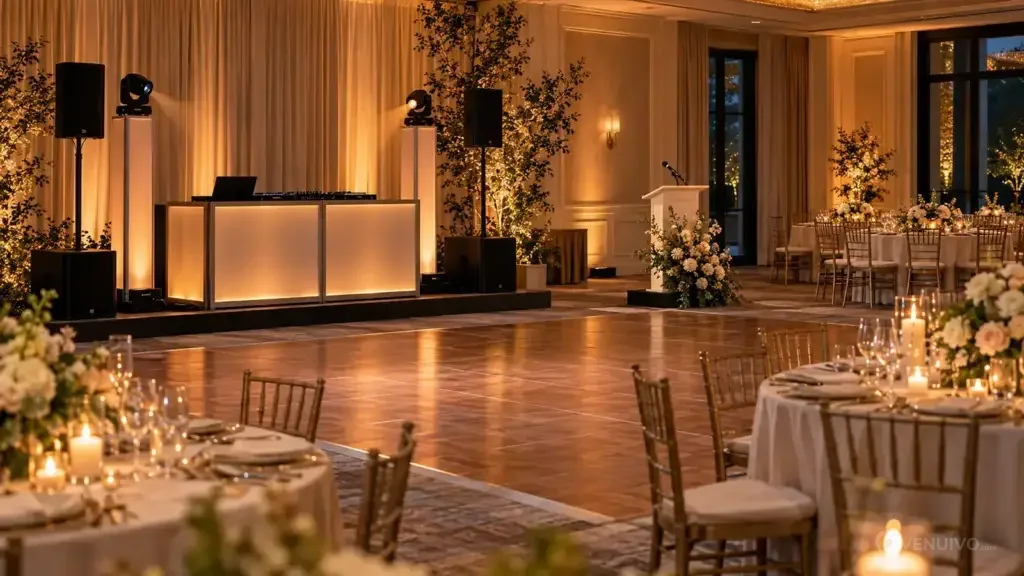
A good wedding sound system is almost unnoticeable: guests understand speeches without straining to hear, the ceremony remains emotional, the dinner is not overrun with bass, and the dance floor comes to life at the right time. Conversely, a microphone that cuts out, a badly placed speaker or a limiter discovered the same evening can disrupt the entire process.
The objective is therefore not to choose "the most powerful system", but to build a coherent chain between the venue, the DJ, the musicians, the officiant, the wedding planner and the people who will speak. This guide helps to prepare specifications, compare proposals, organize tests and plan a backup plan without buying complex equipment yourself.
Start with the moments to be sounded, not the watts
Before talking about speakers or consoles, list the sequences that really need sound. A single wedding can include a ceremony in the garden, a cocktail party on a terrace, a dinner in a separate room and a dance party in an enclosed space. Each move creates a new question of power, coverage, weather and coordination.
| Timing | Main need | Point to be confirmed |
|---|---|---|
| Ceremony | Clean voice, input and output music | Backup microphone and stand-alone system if space is remote |
| Cocktail | Regular atmosphere without covering up conversations | Separate Zone, Power and Rain Protection |
| Dinner | Speeches, announcements and background music | Distributed speakers and easy-to-use mic |
| First dance | Precise music start and progressive level | Signal agreed upon between the couple, the photographer and the DJ |
| Evening | Energy on the dance floor without excessive volume at the tables | Limiter, end time, and venue rules |
This map of uses naturally completes the choice of Wedding DJ. It also makes it possible to distinguish between what the service provider provides, what the venue provides and what must be rented in addition.
Have the room and the sound service provider talk to each other before signing
The couple is not expected to serve as a technical intermediary on the day. Before signing, send the DJ or sound engineer the plan of the venue, the access times, the distances between the spaces and the contact of the technical manager. Then ask for written confirmation of the compatibility of the proposed device.
Check the acoustic stresses and the limiter
Some rooms have a limiter that reduces or cuts off the broadcast when the allowed level is exceeded. You need to know its metering location, setting, post-release procedure, and special bass restrictions. A test in the room is more useful than a general promise: the way the sound is distributed depends on the volume of the room, the materials, the open doors and the position of the speakers.
In France, establishments concerned by the habitual broadcasting of amplified sounds must comply with specific obligations. The Public Health Code provides for a cap of 102 dB(A) over fifteen minutes in places accessible to the public, with other requirements depending on the configuration. This reference does not replace the rules of the venue or local by-laws: the venue manager and the sound professional must confirm the rules applicable to the event. Consult the official text on Légifrance and information from Service-Public information on activity noise.
Confirm the power supply and safe walkways
Ask which outlets and circuits are reserved for sound, light, and other equipment. The caterer, coffee machines, auxiliary heaters or entertainment should not be randomly connected to the same distribution. Temporary installations are also part of the prevention of electrical risks: the INRS reminds us that they must be maintained, monitored and verified.
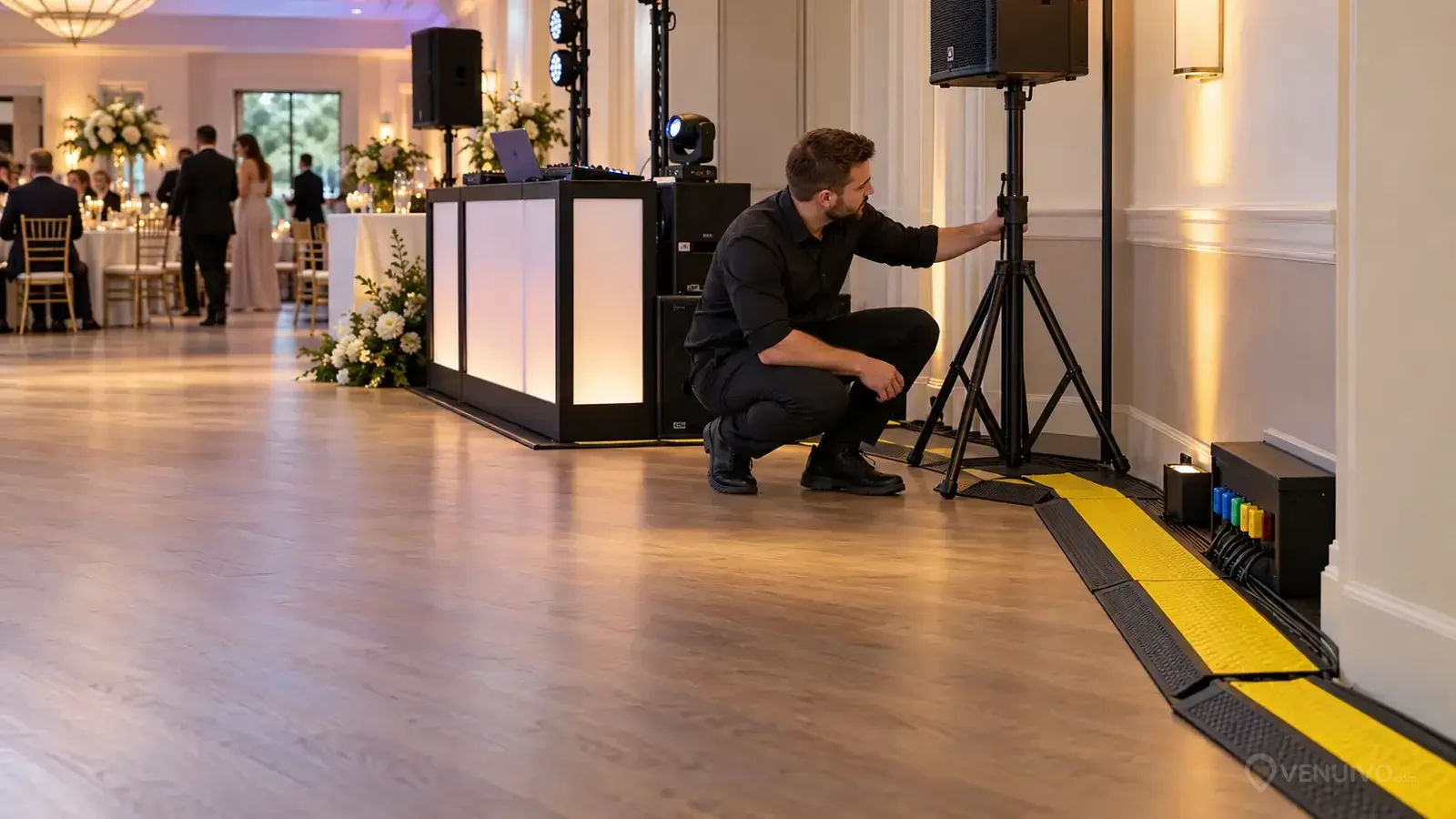
The plan should also show cable passages, speaker stands and access to outputs. Cables that cross a traffic area are protected by suitable passages and do not create obstacles. The couple does not have to improvise this installation: it is up to the professionals and the rules of the place. The technical benchmarks are detailed by the INRS.
Place the speakers to cover the space without overwhelming the guests
Turning up the volume of a single speaker doesn't correct poor coverage. People close to them suffer too high a level while those at the back still struggle to hear clearly. A distribution designed for the geometry of the room often makes it possible to obtain a more homogeneous result at a better controlled overall level.
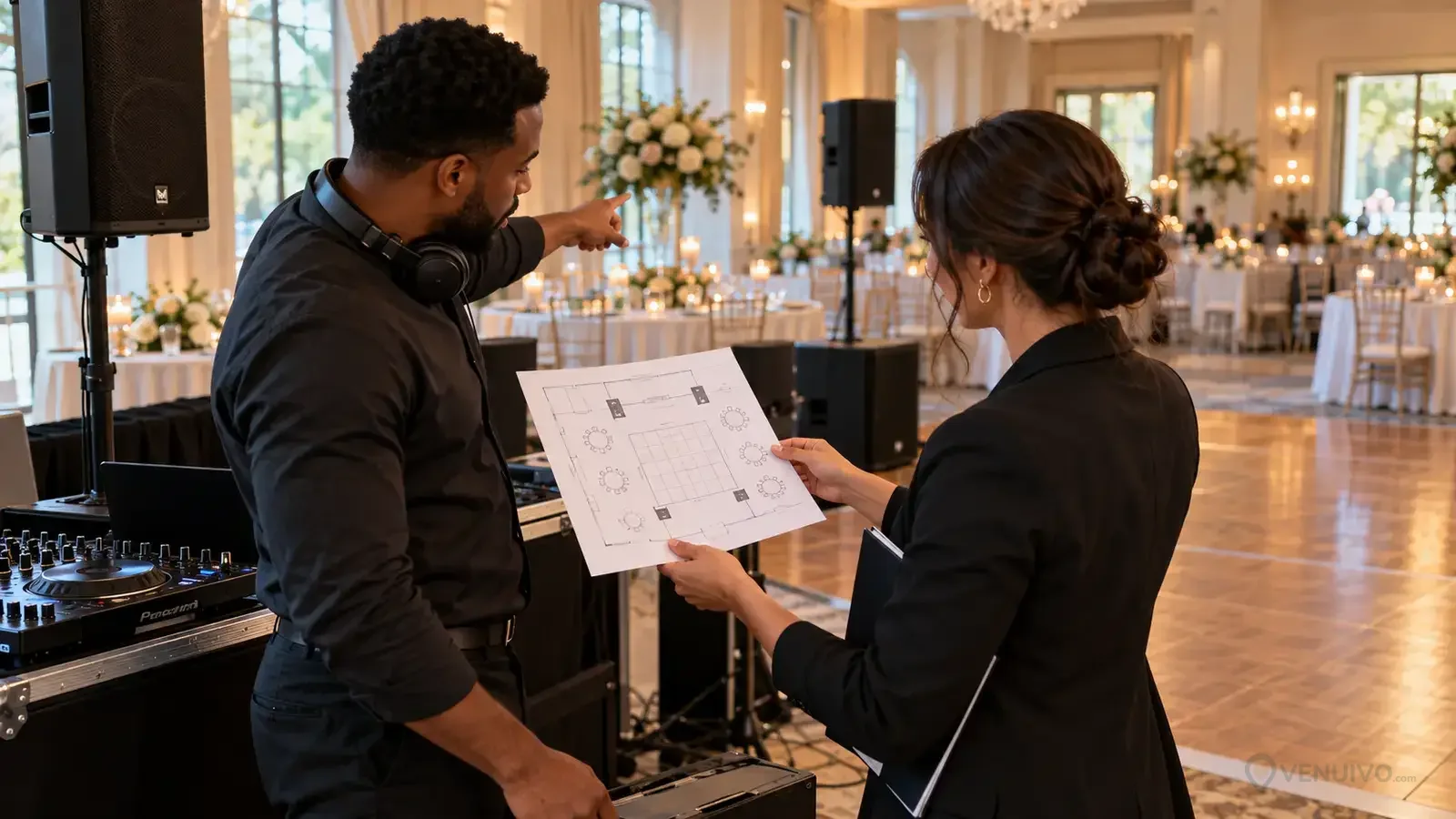
The main speakers are aimed at the dance floor rather than the tables. For a long room, time-aligned delay speakers may be preferable to excessive volume on the façade. Their adjustment must be entrusted to the sound engineer so that speech and music remain synchronized. Also, avoid placing a guest table, a children's area or a sensitive person right in front of a speaker.
Making speeches intelligible from the first word to the last
A successful speech depends as much on the placement as on the microphone. The person speaks in front of the guests, away from the speakers, and holds the microphone at a constant distance. It does not tap the capsule and does not move without instructions. A facilitator or the maître d'hôtel can remind them of these gestures in a few seconds before each intervention.
Choose the microphone according to the use
- Wireless handheld microphone: simple to transmit and suitable for most speeches, as long as you check the batteries and frequency.
- Microphone on stand: useful for successive readings, but the pitch must be adjusted between two people.
- Lapel microphone or headband: practical for the officiant of a ceremony, with special attention to the wind, clothing and jewelry.
- Backup wired microphone: less elegant in photos, but valuable if a radio link or battery fails.
Plan a real voice test
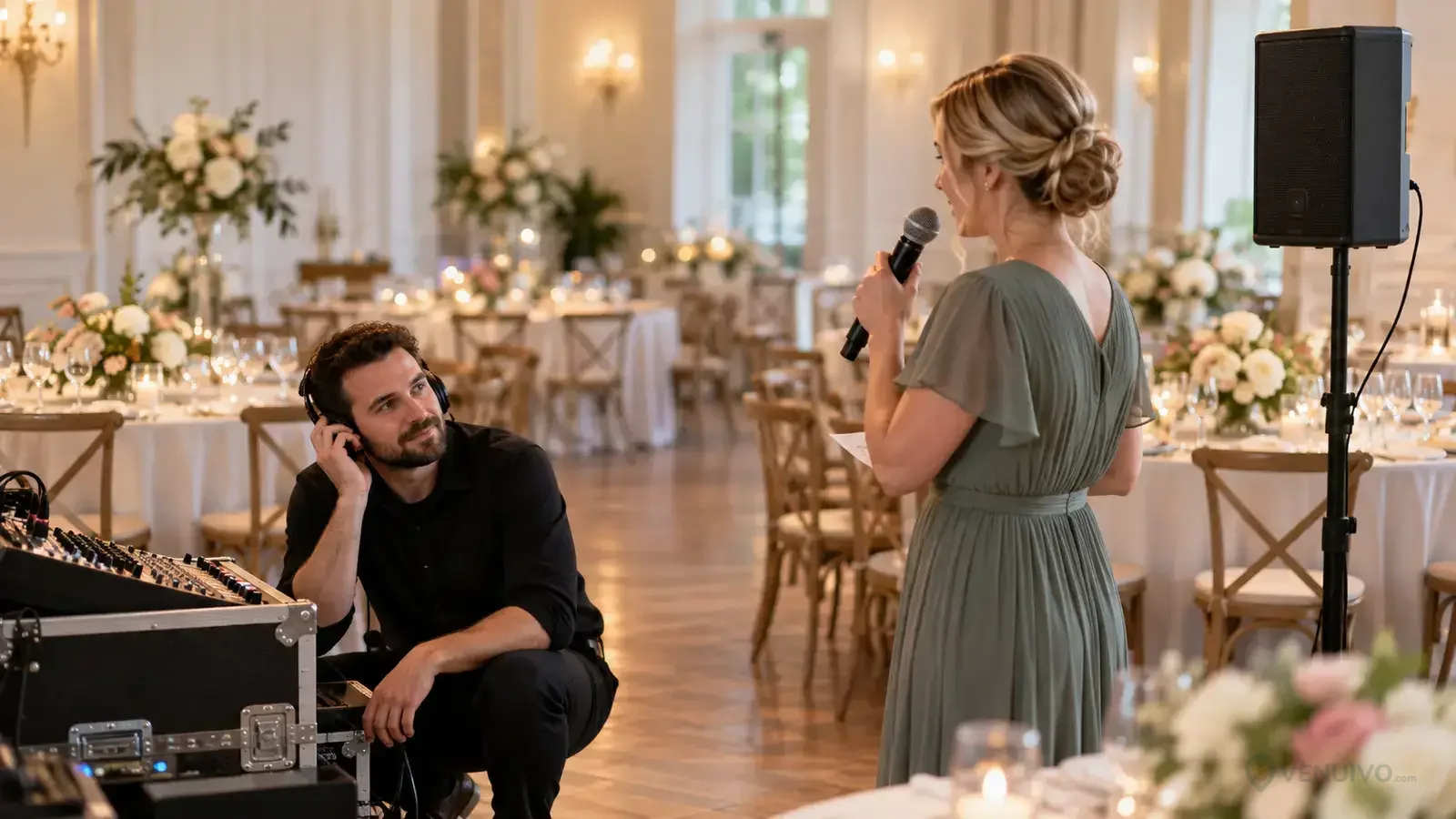
The test is not limited to saying "one, two". One person reads thirty seconds of a text at the volume they will actually use, while another listens from several tables. Check for consonants, low sounds, the risk of feedback, and the transition from music to speech. Persons who intervene during a Secular ceremony can repeat their entry, placement, and microphone handover in the same sequence.
Treat ceremony, cocktail, dinner, and dance floor separately
A single mobile installation may be sufficient if the sequences follow one another with a realistic travel time. Otherwise, two systems or two zones are often more reliable. Ask who is transporting the material, how long does the change take, and what happens if guests move to the next space earlier than expected.
For an outdoor ceremony, the electric range, wind and humidity must be evaluated. No equipment not intended for rain remains exposed. The sound protocol then joins the Plan B Wedding Weather : fallback location, new speaker location, protected cables, and decision time.
During the cocktail and dinner, the background music accompanies the exchanges. Prepare with the DJ a Playlist adapted to every moment, but give him some leeway to adjust the pace and level in the room. The music on the track should not become the volume reference for the entire reception.
Protect hearing and preserve comfort
The sound level and the duration of exposure go hand in hand. The World Health Organization proposes a safe listening standard for venues and events, including a limit of 100 dB LAeq over fifteen minutes, monitoring of levels, hearing protection and rest areas. It is a global prevention framework; Local legal requirements may be different or stricter.
Ask the professional how they measure the level during the evening and how they react if the room fills up, the doors close or the guests demand more volume. Provide quality earplugs, signal a quieter area, and keep children away from speakers. The WHO Global Standard for Safe Listening provides a useful basis for discussing with the venue and the provider.
Building a backup plan that fits in a crate
The backup plan is not a second full show. It covers the breakdowns that would have the most consequences: inability to hear a speech, stopping the music during a key moment or losing an area. The service provider specifies what it brings and what would remain impossible in the event of a major breakdown.
- a backup microphone ready to be plugged in;
- batteries charged and identified;
- Key tracks available offline on two media.
- duplicate essential adapters and cables;
- a small freestanding speaker for an announcement or ceremony;
- a technical contact of the place that can be reached during the installation;
- A paper order of important moments if the network falls.
The DJ also saves exact versions of the entrance, opening and late night music. A title with the right name can exist in multiple edits or durations. The couple therefore validates a specific file or link, not just a piece written in a message.
Compare quotes on verifiable items
A legible quote indicates the number of zones, the duration of presence, the installation hours, the essential equipment, the management room, the dismantling and any travel expenses. He also specifies the limits: live music without sound, decorative lighting, a distant ceremony, an additional band or an extension of the schedule.
| Question | Helpful Answer | Warning signal |
|---|---|---|
| How many areas are covered? | Named ceremony, cocktail, dinner and runway | "All day" without details |
| Who provides the microphones? | Type, quantity, backup and batteries specified | A single microphone with no replacement solution |
| When is the test done? | Window before guests arrive | Discovery of the room during the reception |
| How is the level managed? | Measurement, limiter and rules of the place identified | Promise to "push to the maximum" |
| What happens when it is broken? | Priority equipment and procedure announced | No designated official |
This verification may be attached to the other points of a Banquet hall quote. This way, technical constraints become comparable elements before the deposit, and not surprises added during the week of the wedding.
The technical process of the day
- The service provider accesses the venue at the agreed time and controls the circuits, zones and cable protections.
- The speakers and microphones are installed and tested before the final decoration of the technical passages.
- The room manager, the DJ and the organizer validate the schedules, the limiter and the contacts.
- The key music is tested in its exact version.
- A real voice is listened to from several points in the room.
- People who give a speech receive a very short instruction on the microphone.
- The rescue equipment remains accessible, loaded and known to the team.
- In the end, the dismantling respects the site's schedule and does not block the exits.
Checklist to be validated one week before
- Plan of spaces and number of areas confirmed.
- Technical contact of the room transmitted to the service provider.
- Known limiter, schedules and neighborhood rules.
- Electrical power and reserved circuits validated by professionals.
- Secure cable ducts and speaker stands.
- Assigned primary and backup mics.
- Key music saved on two media.
- Plan B outside or change of room defined.
- Voice and listening test from multiple scheduled tables.
- Hearing protection and quiet zone provided.
Frequently asked questions
How many speakers do you need for a wedding?
The number depends on the shape of the spaces, the number of zones, and the coverage sought, not just the number of guests. Ask the professional for a layout plan rather than a standard number.
Is the DJ's equipment enough for the ceremony?
Not always. A remote ceremony may require a standalone system, a specific microphone, and weather protection. The distance and transfer time must be confirmed before the contract.
Do you need a microphone for a room of 50 people?
Often yes for speeches, because the noise of conversations and the length of the room reduce intelligibility. A well-tuned mic allows you to speak naturally without shouting.
How to avoid feedback during speech?
The person stays behind the speaker line, holds the microphone close to their mouth, and doesn't point it at a speaker. Placement and adjustment are tested before guests arrive.
Can you connect the sound to a conventional power strip?
The couple must not improvise the electrical distribution. The venue and the service provider determine the appropriate circuits, protection and equipment, in accordance with the applicable safety rules.
Who decides the volume during the evening?
The professional controls the sound within the limits set by the place, the regulations and the comfort of the public. The couple can express the desired atmosphere, but should not ask to bypass a limiter or a safety instruction.
In summary
The sound system for a wedding is prepared like a journey: an area, a use, a person in charge and a backup solution for each moment. By having the venue and the provider work together, testing a real voice, and protecting circulation like hearing, you get clearer sound without looking for excessive power. The result is simply measured: the lyrics remain understandable, the music creates the expected energy and the technique never takes the place of the party.